
Pentecostal and Charismatic revivals and renewals brought about positive changes to the way Christians worship. These welcome changes liberated millions of people from the dreary routines of lifeless worship services. Born-again Christians long to worship God in the power of the Spirit, bringing glory to God and edification to fellow Christians.
However, I think many Christians do not have a clear, biblical understanding of worship. We mistakenly assume that there is nothing more to worship than what many call “praise and worship.” “Praise and worship” sessions are indeed a vital part of Christian worship, but it certainly is not what worship is all about. Often we consider external manifestations such as singing, clapping, and dancing as the essence of worship. In this chapter, I shall briefly explain what constitutes true Christian worship. This certainly is not intended to be a comprehensive treatise on Christian worship. I am laying a good foundation for a better understanding of how a good worship service is to be arranged and led. We begin with the Object of our worship.
Have you ever encountered a Jehovah’s Witness? Invariably, the most important question they would ask you is, “Whom do you worship?” Through your answer, they expect to launch their tirade against the doctrine of the Holy Trinity. Jehovah’s Witnesses worship God the Father. They do not consider Jesus or the Spirit as worthy of worship.
The God of the Bible revealed himself to humankind over a long period as the One true God. The revelation of God in Jesus Christ and the Scriptures makes it amply clear that there is more than one person in the Godhead. Jesus Christ and the Holy Spirit are coequal with God in divinity. Thus, there are three distinct Persons in the Godhead. Yet, we have only one God.
We are taught that we worship God the Father, through the Son, in the power of the Holy Spirit. However, all three Persons of the Godhead are worthy of our worship and adoration. The triune God created the world and accomplished redemption through the sacrificial death and resurrection of Jesus Christ. As Christians we are baptized in the name of the Triune God–the name of the Father, the Son, and the Holy Spirit. We pronounce benediction in the name of the Father, the Son, and the Holy Spirit.
There are Pentecostal and Charismatic Christians who focus on just the Holy Spirit. Their worship does not reflect their faith in the Triune God. We should therefore steer clear of such tendencies. Simon Chan in his book Pentecostal Theology and the Christian Spiritual Tradition writes about the need for a balanced Pentecostal spirituality:
“If the doctrine of the hiddenness of the Spirit is taken seriously it will actually produce a balanced Pentecostal. A balanced Pentecostal is one who speaks in tongues, prays for the sick, casts out demons without paying much attention to any of these things in and of themselves. He or she is concerned with, namely, the glorification of Christ. The Spirit is truly glorified precisely when the Father and Son are glorified. That understanding must become a basic part of Pentecostal spirituality.”1
The Ten Commandments begin with Yahweh’s unchangeable command that prohibits the worship of anyone or anything other than the God who revealed Himself to the world through the scriptures. Yahweh revealed Himself through His Son Jesus Christ. Christ is “the image of the invisible God.”2 It pleased God to let “all the fullness of Deity” dwell in Jesus’s bodily form.3 The Bible and the Holy Spirit mediate this grand revelation to us.
The words “God” and “Lord” are pretty generic. People of all religions use these words to refer to their object(s) of worship. Christians in the West are happy with the term “God” because most of them were never exposed to other religions. Their societies were homogenous. Even when their countries are increasingly becoming multicultural, many Western Christians have not understood the need to correctly describe the God they worship. “God bless America” or “God save the king,” they say. Immigrants and followers of other religions are yet to ask them, “Which God are you talking about?”
English-speaking Christians, when asked to recite Psalm 23, will begin with the verse, “The Lord is my shepherd.” That’s not what David wrote. The psalm specifies the name of God. “Yahweh is my shepherd.” English Bible translators took the liberty of rendering the tetragrammaton – the Hebrew name YHWH or Yahweh – as “LORD.” This is one of the biggest disservices these translators did to generations of Christians. Their disregard for the sensibilities of ancient Israelites is unpardonable. No human has the right to replace the sacred name of God with a generic “Lord.” There is no reason why the Hebrew word Hallelu-Yah should be rendered as a bland “Praise the LORD.” Hallelujah is not praise to just about any Lord; it is a call to praise Yahweh.
The term “heavenly Father” is distinctly Christian. No other religion refers to God as the Father. When we read the New Testament, we do not ask, “Which God is this book talking about?” There is no room for confusion. We know we are reading about the God of Abraham, Isaac, and Jacob. The apostle Paul was particular about avoiding ambiguity. At times, he describes God as “the Father of our Lord Jesus Christ.” Can we confidently say that the songs we sing are free from ambiguity? After listening to our songs, will our friends of other religions be assured that our worship services are truly Christian?
When Syrian Christians from West Asia first landed in India on the Malabar shore (Kerala) in the fourth century, they understood the need to differentiate the God of the Bible from the numerous “gods” that were worshipped by people around them. The local king gave them land to build a city. They called it Maha Devar Pattanam, the city of the Most High God. They certainly wanted Indians to know that the God they served was different from and highly exalted above the gods of the land. However, they did not know that one of the Hindu gods was known as Mahadev.
Christian missionaries in northern India faced a similar problem. Which Hindi word would most correctly describe the God of the Bible? The generic term “eashwar” or “bhagwan” could mean anything in a land where people worshipped millions of “gods.” They settled for parameshwar, the Most High God. Even today, Hindi-speaking Christians refer to their God as Parameshwar. Yet the word Parameshwar has its problems. It does not identify the God of the Bible by name. People of other religions can easily use this term for their gods. We must refer to the Heavenly Father by the name He revealed to us. The same applies to the name of our Saviour Yehoshua or Ye’shua—Yah has become our salvation.
I have been through worship services which employed songs that did not contain the name of Jesus—no, not even once! In some “Christian” worship services, we may end up singing songs that praise a generic God or Lord! Some songs do not even mention any God or Lord; they only have pronouns.
For instance, consider this popular song:
You are here
Moving in our midst
I worship you
I worship you
You are here
Working in this place
I worship you
I worship you
Waymaker
Miracle worker
Promise keeper
Light in the darkness
My God
That is who you are
Waymaker
Miracle worker
Promise keeper
Light in the darkness
My God
That is who you are
You can sing this song with great devotion to the God of the Bible. The trouble is that this song can be sung by our Hindu friends who worship Ganesh, the “elephant-headed god.” That god is known as vighnaharta, ‘way maker’—the one who makes way by removing obstacles.
These “Christian” songs depend on worship leaders to provide the missing information. If worship leaders don’t talk about the Lord Jesus or His Father either before or during the singing of these songs, they cease to be “Christian” songs.
Take, for instance, the popular song Ten Thousand Reasons. Why is this even considered a “Christian” song? There is no mention of the Lord Jesus Christ.
Bless the Lord oh my soul
Oh my soul
Worship His Holy name
Sing like never before
Oh my soul
I’ll worship Your Holy name
The sun comes up
It’s a new day dawning
It’s time to sing Your song again
Whatever may pass
And whatever lies before me
Let me be singing
When the evening comes … Chorus
You’re rich in love
And You’re slow to anger
Your name is great
And Your heart is kind
For all Your goodness
I will keep on singing
Ten thousand reasons
For my heart to find … Chorus
And on that day
When my strength is failing
The end draws near
And my time has come
Still, my soul will
Sing Your praise unending
Ten thousand years
And then forevermore
Forevermore … Chorus
You might claim that the first line “Bless the Lord oh my soul” was taken from Psalm 103. This, again, is a misunderstanding caused by modern English Bible versions. King David was indeed sensible. He sang, “Bless Yahweh, my soul …” because he was particular about naming his God. The American Standard Version (1901) rendered it as “Bless Jehovah, O my soul” just as it rendered Psalm 23:1 as “Jehovah is my shepherd.” Jehovah may not be the correct way to pronounce the tetragrammaton. But it was way better than a mere capitalized LORD. Why don’t we just change the first line of the above song?
Bless Ye’shua oh my soul
Oh my soul
Worship His Holy name
Sing like never before
Oh my soul
I’ll worship Your Holy name
It has to be admitted that a few “Christian” songs can cause more than a little embarrassment. During a worship session at a youth camp in Kerala, I noticed that a few young men displayed unusual interest in a Malayalam song that was being sung. In the end, they shouted, “More! More! Repeat!” They were residents who had wandered into the campsite. They were amused to hear Christians sing a love song—a song that compared their relationship with Jesus with the conjugal love between an engaged couple, along the lines of the Song of Songs! Unfortunately, the song did not mention the name of Jesus. Any woman could sing it about her lover.
How can we afford to omit the name of the Lord Jesus Christ from our liturgy, our songs, and our prayers? He is the head of the Church. He has preeminence over everything and everyone. In the name of Jesus, every knee will bow.
Take a moment to listen to a truly Christian song that helps God’s people adore the beautiful name of Jesus!
We need to ask ourselves, “Am I worshipping this God of the Bible?” The tendency to “create” a God of our liking in our minds is dangerous. Our understanding of God should match the Biblical revelation about God. If not, we may conjure up a ‘god’ in our minds according to our imagination. Some people think that God is like corrupt officials who accept bribes to do our bidding! There may be many more who think that God is like their earthly fathers or mothers who were abusive and cruel. For millions, God is like a coin-operated vending machine that grants them their wishes.
Is the picture of God in your mind the same as the one that the words of the Bible paint? If not, you are worshipping a ‘god’ of your imagination. For instance, it is dangerous to believe that God is love if, at the same time, we do not acknowledge that He is a consuming fire that punishes sinners. Likewise, we need to have a balanced, scriptural understanding of God.
All Christians, especially those who once followed other religions, wonder how they should visualize God during worship. In some religions, devotees focus on the physical form of an idol (or a moorthi, that is, a representation of a deity). The Bible does not allow us to visualize God in any form. Instead, we are encouraged to fix our thoughts on Godʼs character and nature. When Moses wished to see God, the Almighty gave him a limited glimpse of Himself. But it’s what God said about Himself that’s impressive:
Then the Lord passed by in front of him and proclaimed, “The Lord, the Lord God, compassionate and gracious, slow to anger, and abounding in lovingkindness and truth; who keeps lovingkindness for thousands, who forgives iniquity, transgression and sin; yet He will by no means leave the guilty unpunished, visiting the iniquity of fathers on the children and on the grandchildren to the third and fourth generations.”4
God wants us to focus on His attributes and His works that reveal His character. We worship God for who He is and what He has done. Therefore, to worship God effectively, we need to study the scriptures to know Godʼs attributes and His wonders. We must also reflect on what God has done for us through Christ. Once we know God thus, we will resist the human urge to fancy a God according to our vain imaginations.
We worship God for who He is and what He has done. Therefore, to worship God effectively, we need to study the scriptures to know Godʼs attributes and His wonders.
We may never have bowed down before any graven image. However, we may have many small idols in our lives—idols that compete to get our love and adoration. Money, ambition, possessions, our loved ones, pleasure, career, or even our church can vie for God’s rightful place in our lives.
Do We Worship To Get Deliverance?
Christian worship is the natural response of those who are redeemed from sin and its consequences.
When the tribes of Israel were delivered from slavery to the Egyptian Pharaoh, they worshipped God under the leadership of Miriam. Indeed, only those who have experienced God’s deliverance today in Jesus Christ can worship him in truth. Worship should not be seen as a means to obtain deliverance. Those who are weighed down by sin and life’s problems should first take victory over these through God. It is not “worship” that sets us free; it’s God! If it were “worship”, worship would be reduced to the level of a magical ritual.
True worship does not begin from the outside. Exuberant singing, clapping, and dancing do not constitute worship if one lacks sincerity of heart. Worship must flow from within. A heart that is full of worship might choose to express itself through various means.
The Lord God pronounced judgment on ethnic Israel because they sought to please God with mere pretence. Their spirituality was devoid of a lively relationship with God. Their sense of right and wrong depended on human traditions rather than on God’s eternal Word.
“Because this people draw near with their words
And honor Me with their lip service,
But they remove their hearts far from Me,
And their reverence for Me consists of tradition learned by rote,
Therefore behold, I will once again deal marvelously
with this people, wondrously marvelous;
And the wisdom of their wise men will perish,
And the discernment of their discerning men will be concealed.”5
It is disheartening to watch worship leaders try hard to “shake up” a congregation with lots of forced outward expressions: “Let’s shout … Let’s lift our hands … Let’s jump … Let’s run around.” Such attempts to ignite hearts from the outside reveal a thorough lack of understanding.
Some even go to the extent of trampling upon those who do not respond to their invitations to “rejoice.” The disrespect shown to the congregation and the ridiculing of those who do not conform to certain behaviours amount to people’s abuse, generally known as “spiritual” abuse, though there is nothing spiritual about it.
Sometimes there may not be any external expressions at all! Take the example of a handicapped person who cannot sing, clap or raise hands. Even such a person can worship the living God with all sincerity and in the Spirit because true worship is a matter of the heart. When it comes to the heart, there should be the following attitudes or qualities in a true worshipper.
We need to be adorned with humility. All that we are and all that we possess came from God’s grace towards us in Christ. Once we understand this, we will not be boastful or arrogant.
“For from Him and through Him and to Him are all things. To Him be the glory forever. Amen.”6
All said and done, the story of human salvation is not about us; it is about God’s love, wisdom, goodness and mercy.
The hearts of true worshippers are filled with joy and celebration. However, at the same time, they must be awe-struck in the presence of their Almighty Creator & Redeemer.
“By the word of the YHWH
the heavens were made,
and by the breath of His mouth
all their host.
He gathers the waters of the sea
together as a heap;
He lays up the deeps
in storehouses.
Let all the earth fear the YHWH;
Let all the inhabitants
of the world
stand in awe of Him.
For He spoke, and it was done;
He commanded,
and it stood fast”7
The hearts of worshippers ought to overflow with love for the God who loved them first. Such expressions of love towards God must be tempered by “fear of God”—a deep respect for God’s justice. That respect leads us to obey God’s Word.
You might be aware of what happened to jubilant worshippers who celebrated God without any regard for His word. They were led by none other than King David.
“David and all Israel were energetically celebrating before Yahweh, singing and playing various stringed instruments, tambourines, rattles, and cymbals. When they arrived at the threshing floor of Nacon, Uzzah reached out and grabbed hold of the ark of God, because the oxen stumbled. Yahweh was so furious with Uzzah, he killed him on the spot for his negligence. He died right there beside the ark of God.”8
God will not overlook a person’s disobedience or disregard for His Word. Lack of obedience or “fear of God” cannot be compensated by an extra helping of adoration.
The heart of the true worshipper is loyal to the one true God. A true worshipper pledges his allegiance to God—not just for Sundays, but on a 24x7x365 basis. God is angry with people whose devotion to Him evaporates like morning dew. He condemned such unfaithfulness in ethnic Israel:
“What shall I do with you, O Ephraim? What shall I do with you, O Judah? For your loyalty is like a morning cloud and like the dew which goes away early”9
It is the responsibility of the worship leader(s) to remind the congregation of these attitudes (through appropriate songs) and to lead them into true worship during the various stages of the worship service.
The fourth main feature of Christian worship is that it takes place in the shadow of the cross of Jesus Christ through whom we have access to God. There is no other way for us to approach a holy God. Therefore, worshippers who approach God should remind themselves about the atoning work of Jesus Christ.
In Old Testament times, Israelites gathered around a Tabernacle to worship God. God had given Moses a detailed plan and layout of the Tabernacle. The first thing that a worshipper encountered at the entrance to the Tabernacle was a bronze altar.10 Priests received offerings and sacrificial animals from worshippers. These would be offered up to God on the bronze altar. Worshippers except Priests and Levites were not allowed beyond this point. Those who served inside the courtyard could move on to the laver that contained water. Further, behind the first curtain, in the holy place, there was an altar where incense was offered to God.
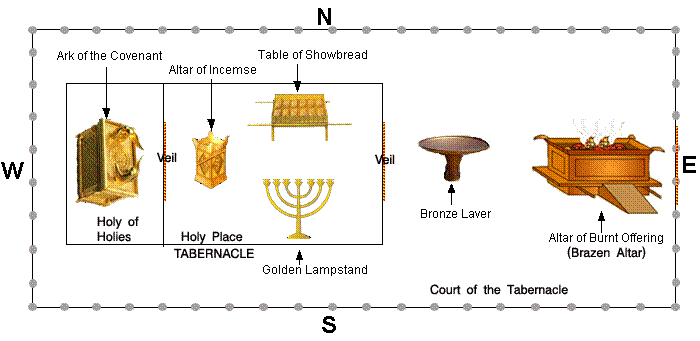
Through this layout, God told the Israelites, “First, deal with your sin through sacrifices and be cleansed of your guilt; then, I shall receive your prayers and praises (symbolised by the burning of incense).”
The High Priest was allowed to enter the Holy of Holies (the holiest part of the Tabernacle) once a year. He had to carry with him the blood of the sacrificial victim (an animal).11 Without the blood of the sacrifice, he wasn’t permitted to approach God. When Christians approach God’s throne by faith they do not need to carry with them blood from any animal sacrifice. Instead, they approach God in the name of Jesus who was sacrificed for them. They cannot escape the shadow of the cross in heaven. When the apostle John received a heavenly revelation, he said, “And I saw between the throne (with the four living creatures) and the elders a Lamb standing, as if slain ….”12 Through this metaphorical imagery, God reminds us that Jesus retains his identity as the Lamb of God forever. We will never reach a time when we can forget about the Cross of Christ. A worship service that does not remind worshippers about the slain “Lamb of God” (Jesus Christ) cannot be called a Christian worship service. Worship leaders must take note of this.
Any worship service that is not characterised by the shed blood of Jesus Christ, the “Lamb of God,” is not worthy to be called “Christian.”
Even though we were once forgiven by God and cleansed by the shed blood of Jesus when we first turned to God, we must continue to receive cleansing from sins that we might commit during our pilgrimage on earth.13 The author of Hebrews reminds us that we should approach God with a conscience cleansed by the blood of Jesus Christ.14 A good worship leader will, at the beginning of a service, lead the congregation into a fresh cleansing by choosing appropriate songs and by letting the participants pray in silence for a few moments.
I have had the misfortune of attending several worship services that did not have the atoning sacrifice of Jesus in the foreground. All the songs sung there were about the Father and the Holy Spirit. My complaint is that there is nothing distinctly Christian about it. Any Jew can attend such a session and shout “Amen!”
How can Christians forget to give Jesus Christ the central place in their “praise and worship” sessions? Let me reiterate that any worship service that is not characterised by the shed blood of Jesus Christ, the “Lamb of God,” is not worthy to be called “Christian.” This is because Christian worship is both the privilege and duty of the redeemed. Here again, Christ and his atoning work are given their rightful place by the choice of songs that extol our Saviour’s sacrifice.
The Blood of Jesus
Reference to the “blood of Jesus” is a way of talking about the great sacrifice which Jesus accomplished for our redemption. Jesus’ blood by itself should not be regarded as a magical charm that protects us. Jesus’ supreme sacrifice has accomplished everything for our salvation.
A “cleansing” or “sprinkling” by the blood of Jesus is a metaphorical way of referring to God’s pardoning of our sins, to give us a clean record. It also alludes to the literal sprinkling of sacrificial blood by Moses on the people of the Old Covenant (Exodus 24:7-8). Hebrews 12:24 and 1 Peter 1:2 refer to the “sprinkling” of Jesus’ blood to underline the fact that born-again Christians of all races, as participants in the New Covenant, are the real Israel of today.
No true worshipper comes to God empty-handed.15 We are commanded to offer three kinds of sacrifices:
Worship bursts forth from within in various forms of outward expressions: physical expressions, vocal expressions, and actions of service/charity.
The word translated as “worship” in the Old (shachah) and in the New Testaments (proskuneo), means “to bow down.” That is how the nations worshipped the gods that they made of wood or stone. The Psalmists invited God’s people to worship the true God with appropriate physical expressions.
“Come, let us worship and bow down, let us kneel before the LORD our Maker.”19
“I will bow down toward Your holy temple and give thanks to Your name.”20
A call to “tremble” before God:
“Worship the LORD in holy attire; tremble before Him, all the earth.”21
And a call to clap our hands and exult:
“O clap your hands, all peoples; shout to God with the voice of joy.”22
These physical expressions must be outward signs of our decision to offer our bodies before God—to be owned by Him, to be used for Him. The sick, the infirm, and the physically challenged cannot be very expressive physically during times of worship. Even those who are physically well may be indisposed to physically expressive worship. God examines our hearts; we would be better off if we did not judge others based on their external demonstrations of worship.
No worship leader should seek to elicit their favourite expressions of worship from any congregation. If a congregation is compelled to do something – clapping, dancing, or whatever – most of it will be hollow and devoid of sincerity. It is also worthwhile to remember that outward expression of worship is not a measure of a person’s relationship with God.
Without realising this significant principle, worship leaders might lash out at quieter participants who are indisposed to highly expressive modes of worship. True freedom is the liberty to express our devotion and worship unhindered by group pressure or fear of rejection. And that includes the freedom to remain quiet and still.
Praise is not prayer. Praise is a sacrifice offered to God as a part of our worship. Praising God involves recounting His miraculous works and extolling Him for all His goodness. We should also praise Him for who He is. Just saying, “Lord, I praise you” or “Praise the Lord!” is not praise. The latter is an invitation to praise God, as is the whole of Psalm 150.
The Psalms abound in praise directed towards God. The Psalmists invite God’s people to sing (new) praises to God and to make a “joyful noise.” The skilful use of musical instruments is enjoined.
Praise Him with trumpet sound;
Praise Him with harp and lyre.
Praise Him with timbrel and dancing;
Praise Him with
stringed instruments and pipe.
Praise Him with loud cymbals;
Praise Him with resounding cymbals.
Let everything that has breath
praise the Lord.
Praise the Lord!23
Not many Christians in the Majority World are talented singers or musicians. But then, devotional singing is not the exclusive preserve of those who are talented and trained. God will be pleased with our best efforts.
However, it would be better to employ the services of trained musicians and vocalists during church services and public meetings. I am aware that the services of trained musicians are beyond the reach of many churches. Only a tiny percentage of our churches can afford to buy musical instruments. Formal music training is costly; therefore, the dreams of most Christian youth to become proficient in musical instruments remain unfulfilled. Here lies an opportunity for Christian musicians to train their brethren free of cost or at a subsidized rate. Trained vocalists can offer their services to train church choirs. Such services are no less a ministry than preaching and teaching.
Singing is not the only way to vocalize our praise. We can praise God using plain speech or through written prose. A British friend, Susanna, uses the language of dance – Bharatanatyam, to be precise – to praise God!
Let us look at some examples of praise in the Scriptures. Psalm 104 begins with an exhortation to oneself to praise God, and it goes on to describe God’s awesome power over creation.
“Bless the LORD, O my soul!
O LORD my God, You are very great;
You are clothed with splendour and majesty …”24
The Apostle Paul praises God by exclaiming,
“Oh, the depth of the riches both of the wisdom and knowledge of God! How unsearchable are His judgments and unfathomable His ways!”25
The book of Revelation has some classic expressions of praise.
“Holy, Holy, Holy is the LORD God, the Almighty, who was and who is and who is to come.”26
“Worthy are You, our Lord and our God, to receive glory and honor and power; for You created all things, and because of Your will they existed, and were created.”27
“Worthy is the Lamb that was slain to receive power and riches and wisdom and might and honor and glory and blessing.”28
And, in the following verse:
“To Him who sits on the throne, and to the Lamb, be blessing and honor and glory and dominion forever and ever.”
Just as God called the new Israel of God, He called the Church to declare the praises of God to the world.
“… you are a chosen race, a royal priesthood, a holy nation, a people for God’s own possession, so that you may proclaim the excellencies of Him who has called you out of darkness into His marvelous light …”29
Thus, being outspoken about the greatness of God is a part of our mission in the world.
When we grow in our understanding of God and what He has done for us, we will be well-equipped to praise Him during our worship services and while preaching to the world.
Next time you are in church, pay attention to each song. How many songs praise God? Do the songs you sing do justice to the greatness of God? Are all His attributes listed and described?
A few churches allow worshippers to praise God verbally during “praise and worship” sessions. Between songs, a few men and women read a passage of praise aloud or praise God in their own words. Ushers may pass a microphone around. Not every worshipper gets to praise God that way. In larger congregations, it is difficult to let several people vocalize their praises loudly.
This is why we need to incorporate some form of written liturgy that allows every participant to verbalize their praise to God. The whole congregation can read it out aloud. The liturgy could be a string of scripture passages that describe and praise God’s greatness. You can have more than one such high praise ready for use on different occasions. Irrespective of how the singing went, the recital of a worship liturgy will give everyone in the congregation an opportunity to declare God’s praises out loud.
Acts of sharing and Christian giving are integral parts of true worship. Our sharing and giving are sacrifices that are well pleasing to God.
And do not neglect doing good and sharing, for with such sacrifices God is pleased.30
The offertory during a worship session allows us to honour God with our possessions. However, Christian giving should not be restricted to church offertory. Any person in need, especially a fellow Christian, deserves our attention.
Let us not lose heart in doing good, for in due time we will reap if we do not grow weary. So then, while we have opportunity, let us do good to all people, and especially to those who are of the household of the faith.31
Contributing to their felt needs gives us tangible opportunities to worship the unseen God. Thus, Christian worship is not limited to “praise and worship” sessions; nor is it, to within the four walls of a church building.
Churches should consider operating a food bank, a clothes bank, a toy bank, et cetera. Anyone in need should be able to receive help without feeling judged or embarrassed. At the same time, there should be some means of ensuring that these facilities are not abused.
After offering our bodies (and thus, our total selves) to God as living sacrifice, we cannot walk away from a worship service as if nothing transpired between God and us. If God has indeed become our Master, we must serve him.
The Hebrew word for worship is sometimes rendered in English as “service.” See how Nehemiah 12:45 is rendered in the New American Standard Bible and the New International Version.
“For they performed the worship of their God and the service of purification, together with the singers and the gatekeepers in accordance with the command of David and of his son Solomon.” – Neh 12:45 NASB.
“They performed the service of their God and the service of purification, as did also the musicians and gatekeepers, according to the commands of David and his son Solomon.” – Neh 12:45 NIV.
Worship and service are not two different things as we might suspect. It is the same thing. This is true of Daniel 3:14, too, where King Nebuchadnezzar uses the word serve in the context of worship. Bowing down before the king’s idol was equivalent to serving his gods.
Nebuchadnezzar responded and said to them, “Is it true, Shadrach, Meshach and Abed-nego, that you do not serve my gods or worship the golden image that I have set up?
To worship God is to serve Him. To serve God is to worship Him. A life of service validates our worship. What does service involve? We must remain loyal to the living God and at His disposal all the time. Such a broad understanding of “worship” or “service” will help us understand Joshua’s declaration that he and his family would serve Yahweh—even if everyone else went after other gods. A Christian who is loyal and attentive to God is at worship 24/7—regardless of whether he is singing or praising God.
To worship God is to serve Him. To serve God is to worship Him. We must remain loyal to the living God and at His disposal all the time.
Elijah the prophet remained true to Yahweh even when Israel pursued Baal. Therefore, when he appeared before King Ahab, Elijah identified himself as a man who served Yahweh. The New International Version renders 1 Kings 17:1 thus:
“As the Lord, the God of Israel, lives, whom I serve, there will be neither dew nor rain in the next few years except at my word.”
If the Hebrew expression is translated literally, “I serve” should be rendered as “I stand”.
“As the Lord, the God of Israel lives, ‘before whom I stand’, surely there shall be neither dew nor rain these years, except by my word.” (Revised Standard Version)
To serve God does not mean that we constantly keep ourselves busy doing something or the other for God. We are called to do God’s bidding at His time. Even when we remain idle, waiting for God’s orders, we remain at His disposal. “They also serve who only stand and wait,” wrote the celebrated Christian poet John Milton. When Milton became blind, he was worried about how he would serve God. When God spoke to him, he wrote this sonnet:
When I consider how my light is spent,
Ere half my days, in this dark world and wide,
And that one Talent which is death to hide
Lodged with me useless, though my Soul more bent
To serve therewith my Maker, and present
My true account, lest he returning chide;
‘Doth God exact day-labour, light denied?’
I fondly ask.
But Patience, to prevent
That murmur, soon replies, ‘God doth not need
Either man’s work or his own gifts; who best
Bear his mild yoke, they serve him best. His state
Is Kingly. Thousands at his bidding speed
And post o’er Land and Ocean without rest:
They also serve who only stand and wait.’
Isaiah had a vision of the God Most High32 After that magnificent angelic “praise and worship” came the question:
“Whom shall I send? Who will go for me?”
And Isaiah offered himself to God’s service, saying,
“Here am I, send me.”
I believe every worshipper must hear that voice thundering from the throne of God. Those who offer mere lip service to God, for whatever reason, will walk away to live their own lives. True worshippers will yield to God’s call and live it out in their daily walk with God.
It is, therefore, of utmost importance to include songs and prayers of consecration towards the close of a worship session. Some excellent hymns and choruses can help us voice our desire to proclaim the gospel, to live a holy life, and to serve Christ.
Besides knowing what the Bible teaches about worship, leaders must learn about the people they lead. We shall consider that in the next chapter.
Proceed to Chapter 3: Understanding God’s People
Philip Eapen, an environmental scientist by training, devoted his life to proclaim the gospel of Jesus Christ ever since he realized that the world needs Jesus Christ more than anyone or anything else. Apart from sharing the good news of Jesus Christ, Philip teaches Christians in order to equip them for service. He is supported by donations from readers. Philip is married to Dr. Jessimol and they are blessed with three sons and a daughter.
Date: May 8, 2023