Evolution Or Creation?
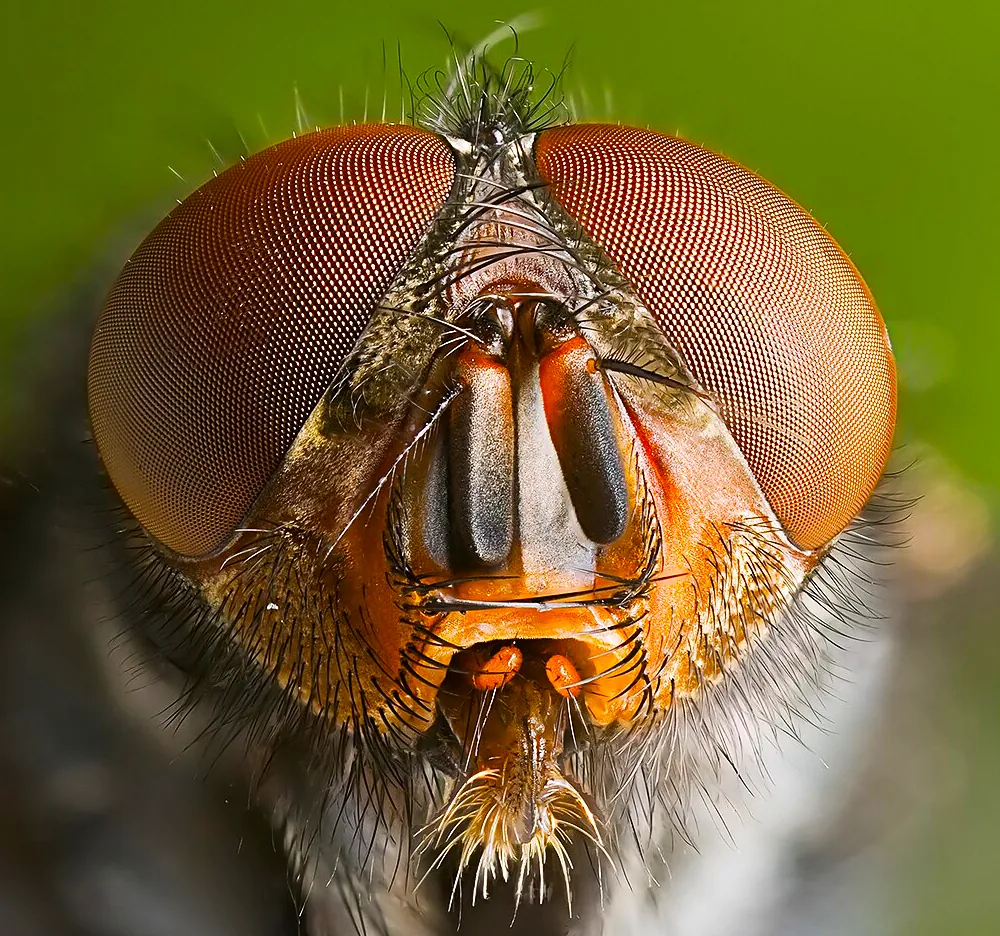
You cannot simultaneously ride two horses that are running in opposite directions. Choose one. Evolution or Biblical Creation narrative?
OUTLINE
- Introduction
- PART ONE: The Biblical Creation Narrative
- PART TWO: The Theory of Evolution
- PART THREE: Refuting Darwin’s Origin Of Species
Good morning! I count it a privilege to be here to lead this seminar on “Evolution Versus Creation”.
I suppose most of us here are Christians. If any of us is from another faith or if you are a person who does not subscribe to any faith, let me take this opportunity to welcome you.
I would like to know:
- How many of us have attended a seminar on Evolution and Creation before coming here?
- I am sure every high school student is taught the theory of evolution. How many of you have studied the theory of evolution at the University level—either at undergraduate or graduate level?
- How many of us have read Charles Darwin’s book, The Origin Of Species?
Let me introduce myself briefly.
- My first degree is in Physics. I am not a biologist.
- However, my graduate degree is in Environmental Studies. It was an inter-disciplinary program. One of the first courses I was taught in this program was Environmental Biology. I had to study the theory of evolution at a higher level. This included a detailed study of the theory that tries to explain the formation of the first living organism. We also had to read about Chemical Evolution and Organic Evolution.
- My second graduate degree is in Christian Theology. I did pursue a PhD in Theology. But I could not complete it due to certain circumstances. However, I am grateful for the opportunity I had to engage in research on Environmental Theology. My topic was based on Genesis 1:26-27 — the creation mandate given to man to exercise dominion over the rest of creation. As a research student, I had the opportunity to examine Christian literature available in India as well as in the libraries of the University of Oxford.
I shall quickly take you through the basic tenets of Darwin’s theory, The Origin Of Species. Evolution is not just about the formation of living species. It is incomplete without the supporting theories of Cosmic evolution, Chemical Evolution and Organic Evolution.
By the end of the day, I hope most of us will gain a basic understanding of the theory of evolution. Besides, I hope you will also be able to explain why the theory of evolution is unsustainable. If any of you think that you can hold on to the Christian faith and to the theory of evolution, my prayer for you is that you will see how incompatible the two are.
Let’s dive in.
PART ONE: The Biblical Creation Narrative
Right on the first page of the Bible, in the first chapter of Genesis, we find the creation story. You may already be familiar with it. Allow me to read it out aloud for us.
1 In the beginning God created the heavens and the earth.
2 Now the earth was without shape and empty, and darkness was over the surface of the watery deep, but the Spirit of God was moving over the surface of the water.
3 God said, “Let there be light.” And there was light! God saw that the light was good, so God separated the light from the darkness. God called the light “day” and the darkness “night.” There was evening, and there was morning, marking one day.
6 God said, “Let there be an expanse in the midst of the waters and let it separate water from water.” So God made the expanse and separated the water under the expanse from the water above it. It was so. God called the expanse “sky.” There was evening, and there was morning, a second day.
9 God said, “Let the water under the sky be gathered to one place and let dry ground appear.” It was so. God called the dry ground “land” and the gathered waters he called “seas.” God saw that it was good. God said, “Let the land produce vegetation: plants yielding seeds according to their kinds, and trees bearing fruit with seed in it according to their kinds.” It was so. The land produced vegetation—plants yielding seeds according to their kinds, and trees bearing fruit with seed in it according to their kinds. God saw that it was good. There was evening, and there was morning, a third day.
14 God said, “Let there be lights in the expanse of the sky to separate the day from the night, and let them be signs to indicate seasons and days and years, and let them serve as lights in the expanse of the sky to give light on the earth.” It was so. God made two great lights - the greater light to rule over the day and the lesser light to rule over the night. He made the stars also. God placed the lights in the expanse of the sky to shine on the earth, to preside over the day and the night, and to separate the light from the darkness. God saw that it was good. There was evening, and there was morning, a fourth day.
20 God said, “Let the water swarm with swarms of living creatures and let birds fly above the earth across the expanse of the sky.” God created the great sea creatures and every living and moving thing with which the water swarmed, according to their kinds, and every winged bird according to its kind. God saw that it was good. God blessed them and said, “Be fruitful and multiply and fill the water in the seas, and let the birds multiply on the earth.” There was evening, and there was morning, a fifth day.
24 God said, “Let the land produce living creatures according to their kinds: cattle, creeping things, and wild animals, each according to its kind.” It was so. God made the wild animals according to their kinds, the cattle according to their kinds, and all the creatures that creep along the ground according to their kinds. God saw that it was good.
26 Then God said, “Let us make man in our image, after our likeness, so they may rule over the fish of the sea and the birds of the air, over the cattle, and over all the earth, and over all the creatures that move on the earth.” God created man in his own image, in the image of God he created them, male and female he created them. God blessed them and said to them, “Be fruitful and multiply! Fill the earth and subdue it! Rule over the fish of the sea and the birds of the air and every creature that moves on the ground.”
29 Then God said, “I now give you every seed-bearing plant on the face of the entire earth and every tree that has fruit with seed in it. They will be yours for food. And to all the animals of the earth, and to every bird of the air, and to all the creatures that move on the ground - everything that has the breath of life in it - I give every green plant for food.” It was so. God saw all that he had made - and it was very good! There was evening, and there was morning, the sixth day.
2:1 The heavens and the earth were completed with everything that was in them. By the seventh day God finished the work that he had been doing, and he ceased on the seventh day all the work that he had been doing. God blessed the seventh day and made it holy because on it he ceased all the work that he had been doing in creation.
As a Christian, if you have never been able to appreciate this creation account in Genesis, I suggest that you should do yourself a favour. Get a copy of Charles Darwin’s Origin of Species and try to read and understand it. After you read Darwin, I can assure you, you will an insane amount of respect for the Bible’s creation account.
The biblical account is simply marvelous.
- It is brief and to-the-point. You can read it, as I just did, in a few minutes. You won’t find it boring or laden with awkward arguments.
- GROUP DISCUSSION
- It belongs to the narrative genre. It is not poetry or fable or myth, as many claim about it.
- It possesses an air of authority or confidence. There are no words or phrases that express uncertainty, probability or doubt.
- It does not attempt to prove the existence of God. Instead, it just declares the presence of God and the acts of God. “In the beginning God ….” What God created – that is, the heavens and the earth and everything in it – are the best collection of evidence of God’s nature and power.
- It tells us that everything seen and unseen – including all life forms on earth – were created by God Almighty. Thereby, it explains the Prime Cause that brought about this universe. The universe did not come into existence by some unguided process that operated on pure chance or blind luck, like a “Blind Watchmaker” assembling a watch.
- Besides, this creation account tells us how the universe and all life forms on earth were created: God called them into existence. The Hebrew word bārā' in Genesis 1:1 is almost exclusively used for God’s creative acts, emphasizing their unique, supernatural nature, unlike human acts of creation.
- The biblical account explains why we still have a seven-day week thousands of years after the world was created. God created everything in the first six days. On the seventh day He rested, indicating the perfection of His works. The Hebrew word for day is yom. Whenever yom is accompanied by words such as evening, morning, or night, it means a literal day. In the fifth verse, we have the words ‘evening’ and ‘morning’. “There was evening, and there was morning, marking one day.” The first day is not called “first day.” Instead it says that the evening and morning, marking one day.
- The biblical account clearly states that God created light before He created anything else. He separated the light on earth from darkness. He called the light “day”, and the darkness, “night.” Light can exist without the sun or the moon, which were created on the fourth day.
- The biblical account deliberately avoids the words “sun” and “moon.” Instead, it refers to the sun as a “greater light”, and to the moon as a “lesser light.” This is because the nations worshipped the sun and the moon. A clear signal was being sent to these nations: the sun and the moon are mere sources of light made by the almighty God. Worship God instead of worshipping these lights.
- The biblical account clearly states that the first living creatures were created on land—not in water!
- The biblical account explains why the universe is so orderly and well organised.
- God made the heavenly bodies follow their set roles;
- God made the times and seasons dependable;
- God made each kind of organism in such a way they produce young ones of their own kind.
- God made each organism in such a way that it occupies its own niche: either on land, in air, or in the aquatic realm.
- Over nine times it is said that animals and plants were created with the ability to reproduce and procreate “according to their kind.” This repetition highlights its importance. No creature can ever produce something other than its own kind.
- The biblical account explains why the world is so good and beautiful; even the Creator observed that everything was very good. Seven times it is mentioned that God saw what He made was good.
- The biblical account explains why different life forms on earth have similar features: God is the common factor; a common Creator left His signature in each of His works
- The biblical account is not based on human knowledge or science but on revelation from God. Critics often are quick to remind us that the Bible is not a textbook of science. Thank God the Bible is not a science textbook! Otherwise it would have had to be amended or modified several times during the last three millennia.
SOME CHRISTIANS: “The Creation Story is a Myth”
The word “myth” – used here – does not mean “fiction” or lie. A myth is a story created to explain complex realities. It is a symbolic narrative expressing foundational, spiritual, or supernatural realities through story
Those who believe that the biblical creation story is a myth believe that:
- The first eleven chapters of Genesis must not to taken literally
- There was no literal Adam, Eve, or the serpent
- There were many human species that evolved from primates on different continents. They all fell into sin. The “Fall of Man” is a parable that explains what happened to humans everywhere.
A CHRISTIAN RESPONSE
I do not think that the first eleven chapters of Genesis is a myth. Why? Because Jesus took the Genesis account of creation and the Flood literally. How do we know that?
- Jesus referred to the first human couple as a real family that serves as a model for all human families. “Have you not read that the one who created them from the beginning made them male and female … Therefore what God has joined together, man must not separate.” – Matt 19:4-6 LEB
- Jesus referred to the “days of Noah” as if it was a real person who lived in history. “For just as the days of Noah were, so the coming of the Son of Man will be.” Matt 24:37 LEB.
- Jesus applied “clay” on the eyes of a man born blind to tell his observers that he was involved in the creation of the first man from the dust of the earth. (John 9:6) Man did not evolve from other animals. Man was crafted by the very fingers of God.
- The apostle Paul took the story of Adam literally. He described Jesus as the Second Adam who came to save the world that got messed up due to the sins of the first human couple. “For just as the days of Noah were, so the coming of the Son of Man will be. … … death reigned from Adam until Moses even over those who did not sin in the likeness of the transgression of Adam, who is a type of the one who is to come.” (Romans 5:12, 14 LEB)
IMPORTANT
- To save the descendants of the individual called Adam, God sent His son Jesus as a descendant of that Adam.
- If the human beings had evolved from different primates on different continents, there would have been no single humanity on earth. Instead, all that we would have had is a set of different human species. Instead of “MAN”, we would have had the White man, Black Man, Brown Man, Yellow Man, etc.
- Each species would then have to get the Son of God born in their race to represent them and to become a sacrifice for them, bearing their sins! The white people would need a white Jesus; the black people, a black Jesus; the yellow people, a yellow Jesus!
- But God sent just one Jesus because the human family is genetically united through Adam and Eve. We all came from one man Adam and his wife Eve. Jesus was able to take away the sins of the whole humanity because He too was born in Adam’s family. He could represent them and become their substitute to bear their sins.
- We have the genealogy of Jesus in the Gospel of Matthew and Luke. The one in Luke is the genealogy of Jesus all the way to Adam. Just as Jesus was a historical figure, Adam was as much historical and real. The genealogy of Jesus Christ – which not many like to read – is the most powerful evidence of the existence of Adam and Eve; and, of the genetic unity of the entire human race.
Evolutionist claim: Death is normal; Death was always present
We know that evolutionists, including Christian evolutionists, believe in natural selection and “the survival of the fittest.” That is, they believe that most suitable organisms survived and reproduced while those that were weaker died without passing on their genetic material to another generation.
- DEATH is portrayed as a necessary evil, a tool that eliminated the ill-suited organisms.
- DEATH is not seen as a consequence of sin.
- If DEATH is not a consequence of sin, how can Jesus save us from our sins by dying for us?
The theory of evolution, incidentally, takes aim at the Cross of Jesus Christ.
- The Bible says, “the wages of sin is death.” Rom 3:23
- Jesus said, “the Son of Man did not come to be served but to serve, and to give his life as a ransom for many.” Mark 10:45 NET
- Peter the apostle wrote: “Because Christ also suffered once for sins, the righteous for the unrighteous, to bring us to God, by being put to death in the flesh but by being made alive in the spirit.” (1 Peter 3:18)
If there is no connection between human sin and death, then Christ died in vain.
PART TWO: The Theory of Evolution
The Darwin Family
As always, there were people who did not accept the book of Genesis as God’s Word.
In England, there is a place called Shrewsbury in Shropshire county. This town is famous because it was there that the Industrial Revolution began with the construction of a large Iron Bridge. I have been to this place and have stayed there for a couple of days.
One of the “englightened” men who lived in Shrewsbury was someone called Erasmus Darwin. Erasmus was a skeptic who rejected traditional religious beliefs. Erasmus studied the created order from an atheistic perspective. In 1794 and 1796, Erasmus published his book Zoonomia in two volumes, explaining his views about the origin of life. He proposed that all life forms arose from a “single living filament.” It was Erasmus who promoted the idea that life forms could improve and evolve into higher and more complex forms through their own “inherent activity” without any external, divine intervention.
Erasmus’ son Robert Darwin was a physician. He inherited his father’s skepticism. But he maintained a nominal connection with the Church of England so that his wealthy patients would not get offended. He also concealed his doubts about God and religion from the women in his household. Once he told his son Charles Darwin that women can get too anxious about the salvation of their male relatives if they came to know that they did not subscribe to traditional religious beliefs.
Charles Darwin was born on 12 February 1809 in Shrewsbury. That very year, Jean-Baptiste Lamarck (Zhon Bah-teest La-mark) offered a fully formed naturalistic theory of evolution. (Naturalism is the view that there is nothing apart from the physical, material world. It is a rejection of the supernatural. When applied to a scientific study, naturalistic methodology keeps God out of the picture.)
Charles Darwin was sent to the University of Edinburgh in 1825, when he was 16, to study medicine; he dropped out after two years. Later, he went to the University of Cambridge to get trained to become a clergyman. After his graduation, in 1831, he went on a geological expedition in Wales. There, he met Capt. Robert Fitzroy of the Royal Navy.
On the 27th of Dec 1831, Darwin boarded the ship HMS Beagle to the South Pacific and coastal areas of South America. During the next five years, Darwin wrote thousands of pages of scientific observations, and collected more than 1,500 specimens of living and fossil life. He spent around five weeks in the Galapagos Islands. After returning to England, he never left Britain.
It was during his voyage on board HMS Beagle that Charles Darwin devised his theory on the origin of species. Darwin did not come up with the idea of evolution. A number of people who lived before Darwin had claimed that all creatures descended from a common ancestor. But it was Darwin who proposed a mechanism by which, according to him, all species on earth descended from a single-celled protozoan.
All of these men – Erasmus, Robert, and Charles Darwin – considered themselves to be “free thinkers” but they were afraid of being socially ostracised from their church and community.
Why did the Darwins Reject the Biblical Doctrine of Special Creation?
I ask this question because I believe motivation is as important as methodology and evidence. Why did Charles Darwin feel compelled to discover an alternative explanation for the existence of millions of species?
Charles was familiar with the Bible. He might have had a little faith in God when he embarked on the voyage. Probably, he was a Deist. According to Deism, God created the world and then withdrew from it so that it could go on forever without His intervention. Darwin, too, could have believed that God set the ball rolling by creating the first living cell. He certainly did not believe that each and every species was created by God’s special creation. He wanted to come up with a naturalistic explanation for the amazing species diversity we see in the world. Over the years, Darwin became an agnostic.
Why did Darwin reject the biblical doctrine of special creation? I present here four main reasons:
- WORLDVIEW: Charles Darwin was influenced by the atheistic, naturalistic worldview in which he grew up
- INSUFFICIENT TIME: Geologists in those days believed that the biblical timeline of roughly 6000 years was not sufficient for the formation of rock layers and fossils. Charles Darwin, too, felt that 6000 years was not enough time for the evolution and diversification of
- NOT SCIENTIFIC ENOUGH: Like his grandfather Erasmus Darwin and other “educated” people of his day, Charles Darwin, did not believe that God created each and every species on earth. According to them, such a belief was not a “scientific explanation.”
- IMPERFECTIONS IN SPECIES: Charles Darwin rejected the notion of perfect Divine Creator/Designer because he found several “useless” organs in humans and animals. How could a perfect God design “useless organs”?
- THE PROBLEM OF EVIL: Charles Darwin rejected belief in an almighty and good (benevolent) God because he could not understand how such a God would permit cruelty and evil in nature.
I present here five main reasons:
1. A NATURALISTIC WORLDVIEW
Charles Darwin grew up under the influence of his grandfather Erasmus and his father Robert. He read his grandfather’s book and left notes in the margins. Charles, too, became an agnostic later in life. But Charles did not wish to acknowledge his grandfather’s influence on his line of thinking. He maintained a strategic distance from his grandfather’s views. He wanted people to believe that his study was a scientific enquiry that had nothing to do with personal philosophical motivations.
But I think the agnostic background in which he was raised played a big role in pushing him towards a naturalistic worldview that denied God any role in the creation of species diversity. He felt compelled to keep God out of the picture while he struggled to explain the origin of species in a naturalistic way.
There were several distinguished scientists who had no problem acknowledging God as the Creator of the universe. Isaac Newton was one of them. But during Darwin’s time, educated folks in England doubted the existence of God. Many believed that life came about without God and that various life forms descended from a common ancestor. But they did not have a theory that could explain the mechanism by which one species could gradually become another species. In this general climate of agnosticism, Darwin came up with a mechanism called “natural selection” to explain the formation of one species from another.
Charles Darwin was one of the first scientists to apply naturalistic methodology to this field of study. Since then, scientists have been promoting an atheistic, materialistic worldview. Today, scientists and professors insist that science must not take God or the supernatural into consideration. They demand a naturalistic explanation even for things that could be happening due to supernatural reasons. Any belief in the supernatural is ridiculed. People who believe in God are not given a fair hearing. Their evidence is not even considered as evidence.
The funny thing is that scientists today have reached a point where they are forced to recognize even those things they cannot observe or measure! Instead of using the word “supernatural,” they use the word “multiverse.” They say that there are other universes that cannot be observed or measured or studied.
The very people who rejected the notion of God and insisted on empirical evidence are now talking about intangible, invisible universes other than our own.
Apart from this philosophical or metaphysical reason, Charles Darwin came up with other reasons for his rejection of the biblical account of creation.
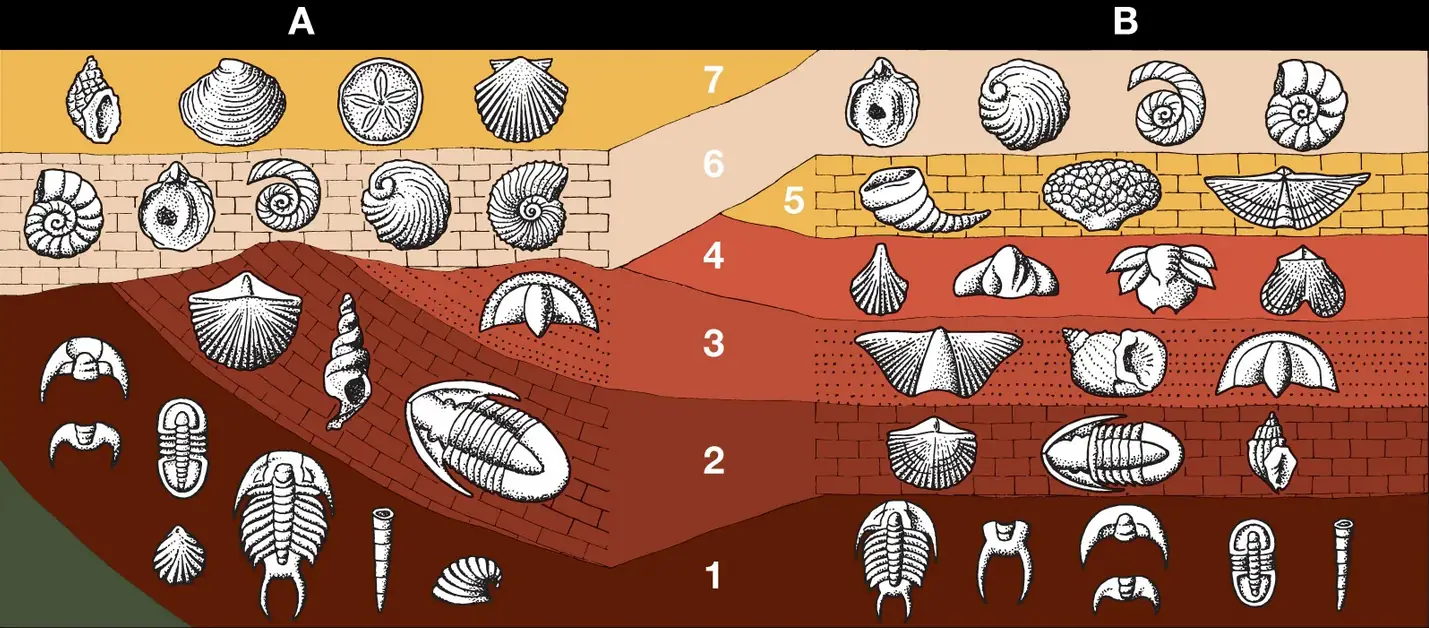
2. DISCOVERY OF ROCK STRATA AND FOSSILS
In the late 18th century and early 19th century, due to increased mining and construction, people in Britain were discovering quite a number of fossils in rock layers. They discovered the fossils of extinct animals in different rock layers. What did geologists and biologist conclude after discovering these fossils? Before we answer that question, we need to look at certain assumptions that geologists had.
Firstly, geologists from that time promoted Uniformitarianism—the belief that all geological processes in the past must have happened at the same speed as seen in similar processes happening today. Charles Lyell was a pioneer of this view. For example, these geologists would argue that if today it takes a 50 years for a small channel in the soil to develop into a gully, and then slowly get deepened through soil erosion to become a deep stream, such a process would have taken 50 years in the past. Similarly, if continents are drifting apart a few centimeters every year, they must have been moving at that rate ever since they started moving.
This belief in the uniform speed of geological processes led geologists like Charles Lyell to conclude that it must have taken millions of years for the formation of various rock layers with fossils in them. ‘If the earth is just 6000 years old as the Bible suggests, how could all these rock layers have formed?”, they wondered.
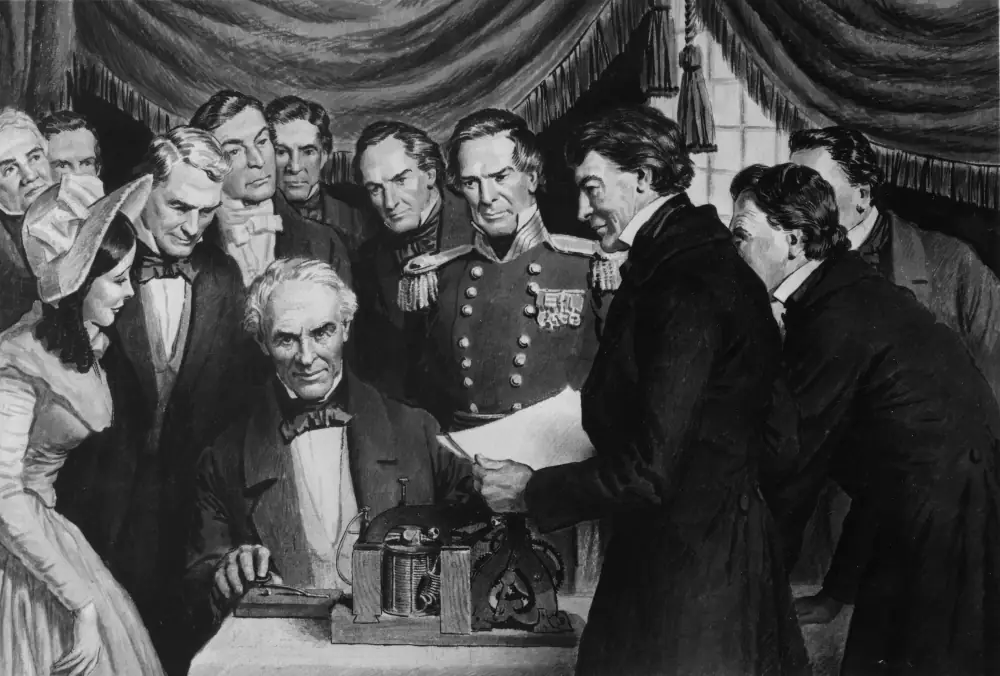
A Scottish preacher, Dr. Thomas Chalmers (1780–1847), who believed the “scholarly” view that the earth was millions of years old, wanted to save the Bible and Christianity from any possible embarrassment. He suggested that Christians should reinterpret the biblical creation story.
In 1814 –45 years before Charles Darwin published his theory – Chalmers began teaching that there must have been a significant “time gap” between Genesis 1:1 and Genesis 1:2.
Chalmers argued that God created the heavens and the earth millions of years ago just as Genesis 1:1 says. According to Chalmers, the animals and plants that God initially created were destroyed in a flood. Those animals got embedded in sediments and became fossilized. After the earth became “formless and void,” God decided to create order and life on earth, as described in the biblical story from Genesis 1:2.
It is astonishing that this faulty view is accepted by many Christians even today. Instead of interpreting the fossil record on the basis of biblical narrative, Chalmers bent backwards to re-interpret the Word of God to make room for the views of some geologists and biologists!
It is astonishing that Christians are willing to bend the holy Scriptures to make room for faulty views that are labeled “science.”
Why do I believe Chalmers was wrong?
I shall cite just two reasons, although there are several:
- In the Ten Commandments, God said that He made the heavens, the earth, the sea, and everything in it in six days.Exodus 20:11. There is no time “gap” between the creation of the heavens and the earth, and the creation of life on earth. There is no gap between the first and second verses in Genesis 1. There is no basis for introducing a “gap” between the first and second verses of the Bible. Even the language and grammar of the text do not support it.
- Genesis 1:3 says God created light.
- There is a biblical way to explain the layers of sedimentary rocks and fossils found in them. You don’t need to invent an imaginary flood called “Lucifer’s flood” prior to the creation of man. The Bible tells us about Noah’s Flood, which can easily explain the formation rock layers in a relatively short time. I shall explain this.
There are thousands of fossil samples all over the world that prove that sedimentary rock layers containing fossils were created in a very short span of time. It did not take millions of years. It just took minutes, or hours, or even a few weeks. It was not a gradual process. The formation of fossils in these rocks happened very quickly.
Take a look at these images of fossilized trees and animals. These vertical fossils of tree trunks cut across several layers of sedimentary rocks. There is no way the tree stood still for millions of years to allow slow deposition of sediments around it, across multiple geological ages! These layers were formed very quickly.

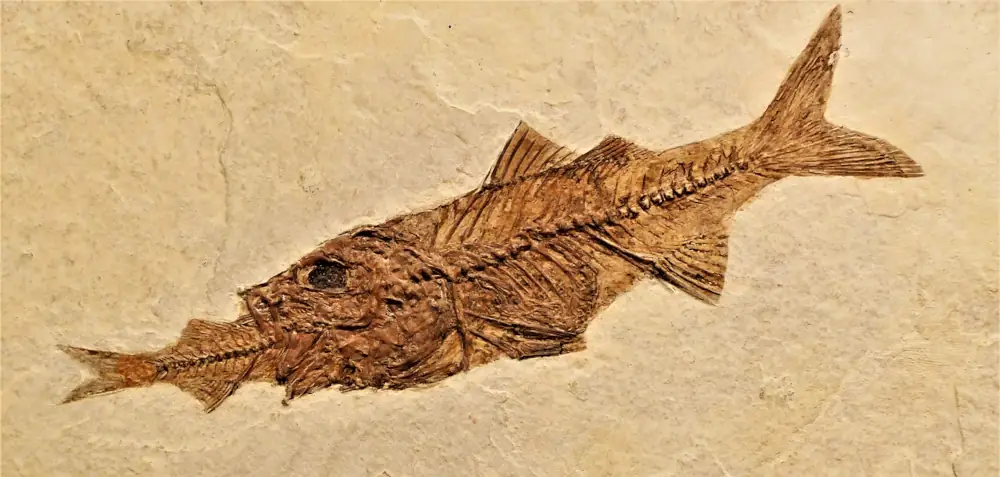
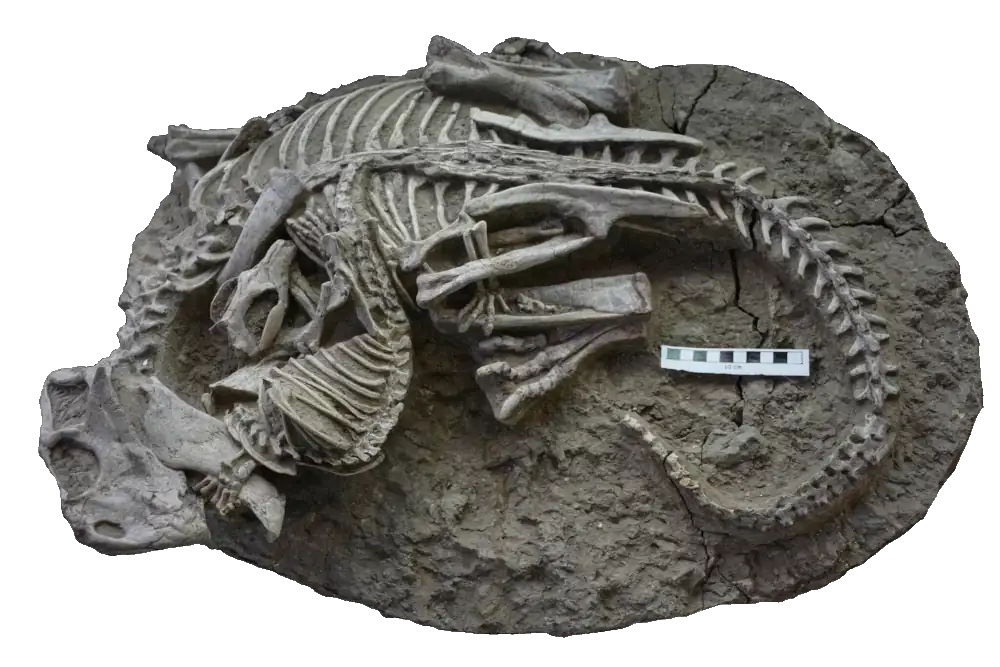
Despite the discovery of thousands of polystrate fossils and fossils that were obviously formed as a result of a catastrophe, geologists who believe in evolution refuse to accept them as evidence. This is because of their arbitrary decision to consider a fossil a “real fossil” only if it is at least 10,000 years old! Such is their bias against any view that goes against their atheistic, naturalistic explanations. You can take an atheist to the waters but you cannot force him to drink.
So, the first question that troubled geologists was, If God created the earth just 6000 years ago, how do we explain the formation of these fossils that must have taken millions of years to form? The second question they asked was closely related to the first.
They found fossils of different kinds of animals in different rock layers. The fossils found in the bottom layers were not found in the upper layers. Many of the fossils of found in the bottom layers were of creatures that are no longer found on earth. Obviously, those creatures had gone extinct. Since the geologists believed that it took “millions of years” for the formation of each rock layer, they concluded that newer forms of life replaced came into existence over millions of years and became successors to the older ones that had gone extinct. They were forced to ask,
If God had created all species in the beginning, how did newer species succeed the older ones in a region after the older ones got extinct?
They concluded that the biblical account of creation was faulty. The earth, they said, was millions of years old. Newer species are being formed. But until Darwin published his work, these British geologists and naturalists did not have a theory that could explain a mechanism by which new species could arise from older ones.
The geologists and biologists who estimated the age of the rock layers and fossils made a cardinal mistake. Their methodology was based on two considerations:
- The order of a rock in a stack of rock layers; and
- The use of fossils to date a rock layer; and the use of such dated rock layer to determine the age of a fossil found elsewhere in a similar rock layer.
The first one is logically sound. In any undisturbed stack of rock layers, a layer found at the bottom is the oldest and the layer found at the top is the youngest. This is the Law of Superposition discovered by Christian Steno in the 17th century. He is regarded as the father of Geology. He also said that all sedimentary rock layers were originally laid down horizontally. I have no problem in accepting these laws of geological science. Although Steno studied rock layers, he continued to remain a devout Catholic. He never felt the need to go against the biblical creation narrative.
But the second consideration stated above is a logical fallacy. Suppose they found a fossil of a Trilobite in a rock layer. They would then date the rock on the basis of that “index” fossil and call it “Cambrian” (around 540 million years old). Suppose they found another fossil in a similar rock layer at another site. There, they would guess the age of the fossil on the basis of the rock layer! This is a classic case of circular reasoning. They dated the rock on the basis of fossils; and they date fossils on the basis of which layer they come from. Geologists and biologists were guilty of this error.Today’s scientists claim to overcome this error by using High-Precision Geochronology to date volcanic ash layers (tuffs) that are sandwiched between fossil layers.
“The intelligent layman has long suspected circular reasoning in the use of rocks to date fossils and fossils to date rocks.”J. E. O’Rourke, American Journal of Science, 1976, 276:51
Geologists studied rock layers all over the world. Using their faulty dating methods, they came up with a diagram that showed the ideal geological time scale.
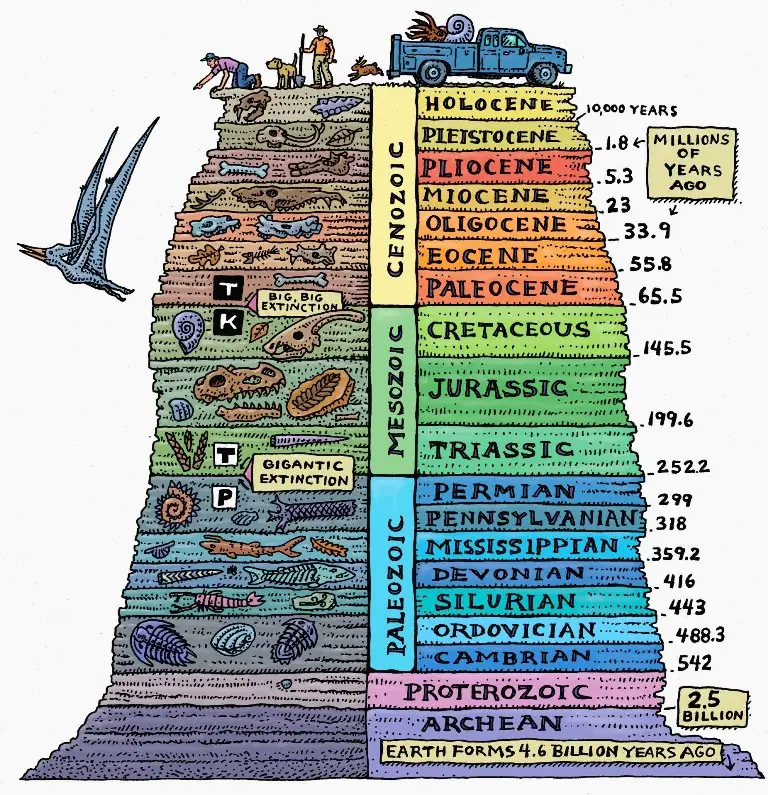
There are a few problems though. None of the rock layers on earth come with labels such as “Pre-Cambrian” or “Cambrian” or “Permian.” The labels are a result of geologists’ interpretations based on circular reasoning. Most importantly, ALL these rock layers cannot be found together in this order anywhere on earth! This strata of rocks with ALL these layers is found only in textbooks and museums of Geology.
3. SPECIES DIVERSITY
Charles Darwin and his grandfather Erasmus found it difficult to believe that God could have created millions of species found on earth. It was clearly as issue of faith. Their understanding of God was so limited. They also felt that a supernatural explanation regarding the origin of species was not scientific enough. They argued that science has to be empirical (that is, based on experiments and practical experience.)
As of 2025, there are approximately 2.5 million known species on the planet. This could be just a fraction of the total species!
- Animals: Only 1.5 million of the estimated ~7.77 million have been described
- Plants: ~300,000 to 390,000 described species.
- Fungi: Only around 150,000 out of an estimated total of 2.2 million to 3.8 million have been described.
- Insects: 1 million cataloged
- Microbes: For every species cataloged, it is estimated that 100,000 microorganisms remain undiscovered.
With all the technological progress that human achieved during the past century, we have barely scratched the surface of biodiversity. Around 80% of total terrestrial species and 90% of aquatic species are yet to be discovered.
During Darwin’s time, scientists were aware of only a fraction of what a 21st century biologist is exposed to. Darwin claimed to have gathered a “mountain of evidence” to prove his theory. Considering the severe limitations in human knowledge in 19th century, it can be safely said that Darwin’s “mountain of evidence” for evolution was not even the size of a mole hill. And yet, Darwin postulated that all living species descended from a single unicellular life form through natural selection. This is like observing 1% of books in a library and proposing a theory on the origin of all the books. The audacity of “enlightened” men who engage in such follies and still call themselves Homo Sapiens, the wise ones!
4. “IMPERFECTIONS” IN NATURE
Darwin claimed that there were several imperfections in the animal and plant world. One of his arguments is about vestigial organs. He referred to such organs as “rudimentary” or useless organs.
He asked: Why do animals and humans have “rudimentary, atrophied and aborted organs”? Why do calves in the embryonic stage have teeth? Why do humans have an appendix or muscles of the ear, wisdom teeth, the tailbone, body hair, and the semilumar fold in the corner of the eye? If God had created each species with a purpose, why did he include such useless parts? Darwin claimed that these organs served various purposes in the evolutionary past of these animals. These organs are “leftovers” from the evolutionary process. As far as Darwin was concerned, vestigial organs prove the theory of evolution. It also proves that God did not create each and every species.
There was a small problem, though. Darwin could not explain why “useless” organs continued to exist in humans or animals for all these “millions of years”. Once an organ has been rendered useless, why was it not dropped through natural selection? Darwin did not have an answer to that question!
Darwin listed a dozen “useless” parts in the human body. In 1893, Robert Wiedersheim expanded Darwin’s list to 86. He included the tonsils, adenoids, third molars, and valves in veins. Evolutionists used this list to mock the human body as a “veritable walking museum of antiquities.”The World’s Most Famous Court Trial, Dayton, TN: Bryan College, 1990. In 1986, evolutionist Alfred Romer published a book titled, The Vertibrate Body. In it, he said this about the appendix: “Its major importance would appear to be financial support of the surgical profession.”A. S. Romer and T. S. Parsons, The Vertibrate Body, Philadelphia: Saunders College Publishers, 1986, p. 389.
There are two problems with this kind of reasoning.
- The first is circular reasoning. Evolutionists argue that vestigial organs were produced as a result of natural selection. Then, they turn around and cite the existence of these organs as evidence of evolution!
- Secondly, just because evolutionists do not know the function of an organ, it does not mean that the organ is useless. Medical science has discovered how vital all these “useless” organs are for human life!
Just because evolutionists do not know the function of an organ, it does not mean that the organ is useless!
The Appendix is not a “useless” digestive remnant. It supports immunity and serves as a storehouse of gut bacteria. The tail bone is not a “useless” remnant of a tail. It serves as a muscle anchor for pelvic stability. The tonsils are our first line of defense against infections. The pineal gland helps with sleep regulation. The thymus is essential for our immune system.
Some organs serve a useful purpose during embryonic stage. After birth, these organs may remain apparently useless. For example, during fetal development, blood is shunted from the pulmonary trunk to the descending aorta through the ductus arteriosus. This is used to bypass the lung. After birth, blood is sent to the lungs. This duct is then rendered useless.
5. THE PROBLEM OF EVIL
After the publication of his book The Origin Of Species, Darwin wrote to a friend,
“There seems to me too much misery in the world. I cannot persuade myself that a beneficent and omnipotent God would have designedly created the [parasitic wasp] with the express intention of their feeding within the living bodies of caterpillars, or that the cat should play with mice.” Quoted in Steven Jay Gould, “Nonmoral Nature,” in Hen’s Teeth and Horse’s Toes, New York: W.W. Norton, 1983.
According to Darwin, if God is all powerful, He must remove all suffering from the natural world. If God is merciful and benevolent, He must not allow one animal to cause harm to another. How can a good God allow a tiger to kill a hog or a buffalo, for instance? Since there is so much suffering in the natural world, he concluded that there God was neither good nor all-powerful. In other words, Darwin rejected the God of the Bible.
The question of suffering is an old one. If Darwin had continued his studies at Cambridge and had become a priest, he would have had his answers. The Bible says that God created a perfect world without pain or suffering. It is human sin that subjected every creature to pain and decay. Less than a century after Darwin’s book was published, the world went through two World Wars and a holocaust. We cannot blame God for the moral and natural evils that are there in today’s world.
And yet, God offers a new heaven and a new earth to those who will receive his salvation through Jesus Christ. The prophet Isaiah describes the much-awaited Messiah and his kingdom:
A Shoot will grow out of Jesse’s root stock,
a Bud will sprout from his roots.
The Yahweh’s spirit will rest on him -
a spirit that gives extraordinary wisdom,
a spirit that provides
the ability to execute plans,
a spirit that produces
absolute loyalty to Yahweh. …
Justice will be like a belt around his waist,
integrity will be like a belt around his hips.
A wolf will reside with a lamb,
and a leopard will lie down with a young goat;
an ox and a young lion will graze together,
as a small child leads them along.
A cow and a bear will graze together,
their young will lie down together.
A lion, like an ox, will eat straw.
A baby will play over the hole of a snake;
over the nest of a serpent
an infant will put his hand.
They will no longer injure or destroy
on my entire royal mountain.
For there will be universal submission
to the Yahweh’s sovereignty,
just as the waters completely cover the sea.Isaiah 11:1-1,5-9
Darwin’s Theory: Natural Selection
The main question that troubled Darwin and other thinkers of his day was: How did all the millions of species originate?
- When a European ventures out into the Tropics, he encounters many more life forms than those that are seen in the temperate or polar regions. It is natural that they wonder: “Where did all these species come from? Surely God could not have created all these millions of life forms, could he?”
This is what Darwin concluded at the end of all his travel, research, and observations:
- God has nothing to with the formation of the diverse species on the planet.
- The species are not immutable; one species can change into new species through random and unguided changes (“fine gradations”) of which beneficial changes are passed on to subsequent generations through “natural selection” over millions of years.
- All animal and plant species on earth descended from common ancestor.
Darwin did not publish his ideas for over twenty years. He kept studying various animals and plants. He thought he had gathered a “mountain of evidence” over the years to prove his theory.
In the meantime, Darwin read the works of a priest called Malthus, who was worried about population explosion. He believed that human population growth would lead to scarcity of resources and a struggle for survival. Malthus’ writings influenced Darwin. In his own words:
“… it at once struck me that under these circumstances [in which plants and animals the struggle for existence] favorable variations would tend to be preserved, and unfavorable ones to be destroyed. The result of this would be the formation of new species. Here then I had at last got a theory by which to work.”Charles Darwin, The Origin Of Species, ed. Charles W. Eliot, Danbury, Connecticut: Grolier, 1909. p. 6.
Darwin rushed to publish his theory in the form of a book titled, On the Origin of Species, in 1859, after receiving a letter from Alfred Russel Wallace. Wallace indicated that he was arriving at a theory of origins that sounded similar to Darwin’s theory. To beat Wallace, Darwin quickly published his book. Only 1250 copies were printed at first. All the copies were sold off in a single day!
Atheists Hailed The Book
One of those who obtained a copy was Friedrich Engels who lived in Manchester at that time. He wrote to his friend Karl Marx about this book:
Darwin, by the way, whom I’m reading just now, is absolutely splendid. There was one aspect of teleology that had yet to be demolished, and that has now been done. Never before has so grandiose an attempt been made to demonstrate historical evolution in Nature, and certainly never to such good effect.Friedrich Engels, “Engels to Marx in London, 12 December 1859." Marx & Engels Collected Works, vol. 40, International Publishers, 1983, p. 550.
To put this in today’s language:
Darwin, who I’m reading right now, is straight-up awesome. He totally crushed the last bit of that old-school “everything has a purpose” nonsense in nature. No one’s ever pulled off such a massive, epic explanation of how nature evolves over time—and nailed it so perfectly.
Karl Marx read On the Origin of Species a year later. He was very enthusiastic about it. Later, he wrote that this book ‘contains the basis in natural history for our view’.
These atheists were so glad that someone had come up with an explanation for the origin of life and life forms that did not require belief in God.
EVOLUTION: SIX DIFFERENT MEANINGS
Evolution has six different meanings:
1. COSMIC EVOLUTION: the origin of space, matter, time, etc.
2. CHEMICAL EVOLUTION: the origin of higher elements from Hydrogen
3. STELLAR AND PLANETARY EVOLUTION: The origin of stars and planets. Even though there are enough number of stars out there for each human to have a trillion or two to their name, no one has ever seen the formation of a star!
4. ORGANIC EVOLUTION: The origin of life from inorganic substances. No one knows how life can originate from non-living things. No one has ever seen a protein molecule form naturally outside the body of an organism!
5. MACRO EVOLUTION: The origin of species (speciation) from other species.
6. MICRO EVOLUTION: Variations within each kind of living creature.
PART 3: REFUTING DARWIN’S ORIGIN OF SPECIES
In the final part of this study, I would like to bring to your attention certain difficulties we have with the Theory of Evolution. First, I shall take you through the “difficulties” that Charles Darwin himself has pointed out in his book. After that, I shall point out some serious problems with Darwinism.
A. “Difficulties” Of Darwin’s Theory
Darwin wrote about a few “difficulties” he faced with his theory. Instead of taking these “difficulties” seriously, he tried to explain these away. Evolutionists who came later, sadly, imitate Darwin. They refuse to consider any evidence that could threaten their atheistic worldview or the theory of evolution.
- Lack Of Transitional Species
- The Problem of “Peculiar Species” and “Perfect” Organs
- The Problem of Complex Instincts
- The Problem of Inter-Species Breeding
1. LACK OF TRANSITIONAL SPECIES/ FOSSILS
Darwin wrote in his book, “First, why, if species have descended from other species by fine gradations, do we not everywhere see innumerable transitional forms?”Charles Darwin, The Origin Of Species, p. 169.
In other words, If one species became another through the retention of small, beneficial changes over millions of years, where are those intermediate organisms?
DARWIN’S ANSWER: Transitional forms go extinct because they cannot compete with the newer forms that came into existence.
OBJECTION: Where is the fossil record for those transitional forms that went extinct? There should be millions of such fossils. There are hardly any.
DARWIN ADMITS: The fossil record is “extremely imperfect and intermittent record.”Charles Darwin, The Origin Of Species, p. 175. In other words, there’s insufficient evidence to claim that intermediate life forms even existed. This clearly shows that each species on planet earth is pretty much quantized. The species are well defined, just as God had said. Each kind of animal or plant was supposed to produce its own kind.
2. PROBLEM OF “PECULIAR” SPECIES AND “PERFECT” ORGANS
How can we explain the origin of animals or birds with peculiar nature such as the mammal that can fly — the bat? Or, how can evolution explain organs that are vastly different in complexity and purpose?
Quite interestingly, Charles Darwin admits these difficulties. But any serious student of science should be concerned about the way he dismisses these difficulties in an unscientific manner.
“Can we believe that natural selection could produce, on the one hand, an organ of trifling importance, such as the tail of a giraffe, which serves as a fly-flapper, and, on the other hand, an organ so wonderful as the eye?”Charles Darwin, The Origin Of Species, p. 169.
By the way he acknowledges the “wonderful” organ such as the eye, you may think that he was about to dump his theory. But that’s not the case. There is blindness. Then, there is wilfull blindness.
“It has been asked by the opponents of such views as I hold, how, for instance, could a land carnivorous animal have been converted into one with aquatic habits; for how could the animal in its transitional state have subsisted? … If a different case had been taken, and it had been asked how an insectivorous quadruped could possibly have been converted into a flying bat, the question would have been far more difficult to answer. Yet I think such difficulties have little weight.”Charles Darwin, The Origin Of Species, p. 175.
What do you call a man who dares to build a tall building even though he knows that the structure is already tilting to one side? What is he says like Darwin, “Such difficulties don’t matter”? Darwin goes on to tell his readers that the case of bats is a thorny issue. He was unable to find any “transitional” species that connect the flying lemur and a bat. And yet, he claims that such transitional species must have existed in the past!
“Here, as on other occasions, I lie under a heavy disadvantage, for, out of the many striking cases which I have collected, I can give only one or two instances of transitional habits and structures in allied species; and of diversified habits, either constant or occasional, in the same species. And it seems to me that nothing less than a long list of such cases is sufficient to lessen the difficulty in any particular case like that of the bat.”Charles Darwin, The Origin Of Species, p. 175.
“Now look at the Galeopithecus or so-called flying lemur, which formerly was ranked amongst bats, but is now believed to belong to the Insectivora. An extremely wide flank-membrane stretches from the corners of the jaw to the tail, and includes the limbs with the elongated fingers. This flank-membrane is furnished with an extensor muscle. Although no graduated links of structure, fitted for gliding through the air, now connect the Galeopithecus with the other Insectivora, yet there is no difficulty in supposing that such links formerly existed, and that each was developed in the same manner as with the less perfectly gliding squirrels; each grade of structure having been useful to its possessor.”Charles Darwin, The Origin Of Species, p. 176.
The unscientific way in which Charles Darwin built his theory upon suppositions after suppositions! It is even more mind-boggling to think that several generations of “enlightened” folks went after this Pied Piper, just because it gave them a way to keep God out of the picture.
THE CASE OF THE FASTEST ANIMAL
Which is the fastest animal?
It’s the Peregine Falcon. It can fly at a speed of 242 miles/hr (387km/hr) while it dives to attack its prey.
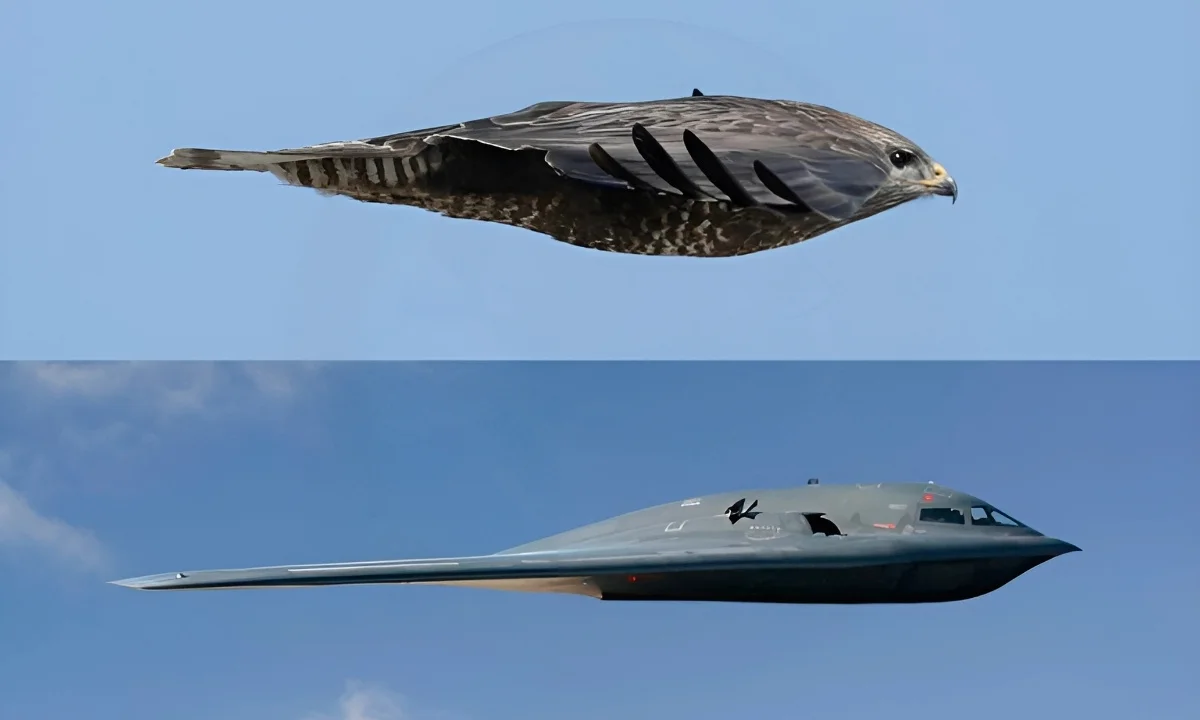
When a peregrine falcon strikes prey at a speed of 242 miles per hour, it makes contact with its clenched feet, delivering what is essentially a high-speed “aerial punch.” Grabbing a prey mid-air could result in a collision. The aerial punch allows it to:
Deliver blunt-force trauma: The impact is often powerful enough to stun the prey, break its back, or even decapitate it instantly.
Avoid immediate entanglement: After the strike, the falcon often continues past the target to bleed off speed before turning around to retrieve the falling prey.
You might wonder why the Falcon isn’t injured during this high-speed aerial attack. The peregrine falcon has several biological features that allow it to withstand the immense forces (often exceeding 20-25G) involved in such a high-speed collision:
Angle of Impact: Falcons rarely hit their prey perpendicularly; instead, they strike at an acute angle, brushing or “clipping” the target. This glancing blow transfers enough energy to kill the prey while allowing the falcon to maintain its own momentum and avoid a direct, bone-shattering stop.
Rapid Pull-Out: Just before impact, the falcon uses its powerful flight muscles and large keel to “put on the brakes” or change its flight path.
Reinforced Anatomy: The peregrine’s skeleton—particularly the sternum (keel) and wing bones (humerus, radius, and ulna)—is significantly denser and stronger than that of other birds. This increased mineral density allows these structures to withstand extreme mechanical stress and abrupt load changes.
Structural Stability: Its bones, such as the humerus, have rounder cross-sections and thicker walls (low K values), which provide superior resistance to the bending and torsion forces generated during a high-speed strike.
Impact Absorption: Their bones have internal structures designed to flex and dissipate energy, absorbing vibrations that would otherwise cause internal damage.
Precision Control: Just before impact, they can unfurl their wings slightly to adjust their path or use “proportional navigation”—the same steering logic used by modern missiles—to ensure a safe and accurate hit.
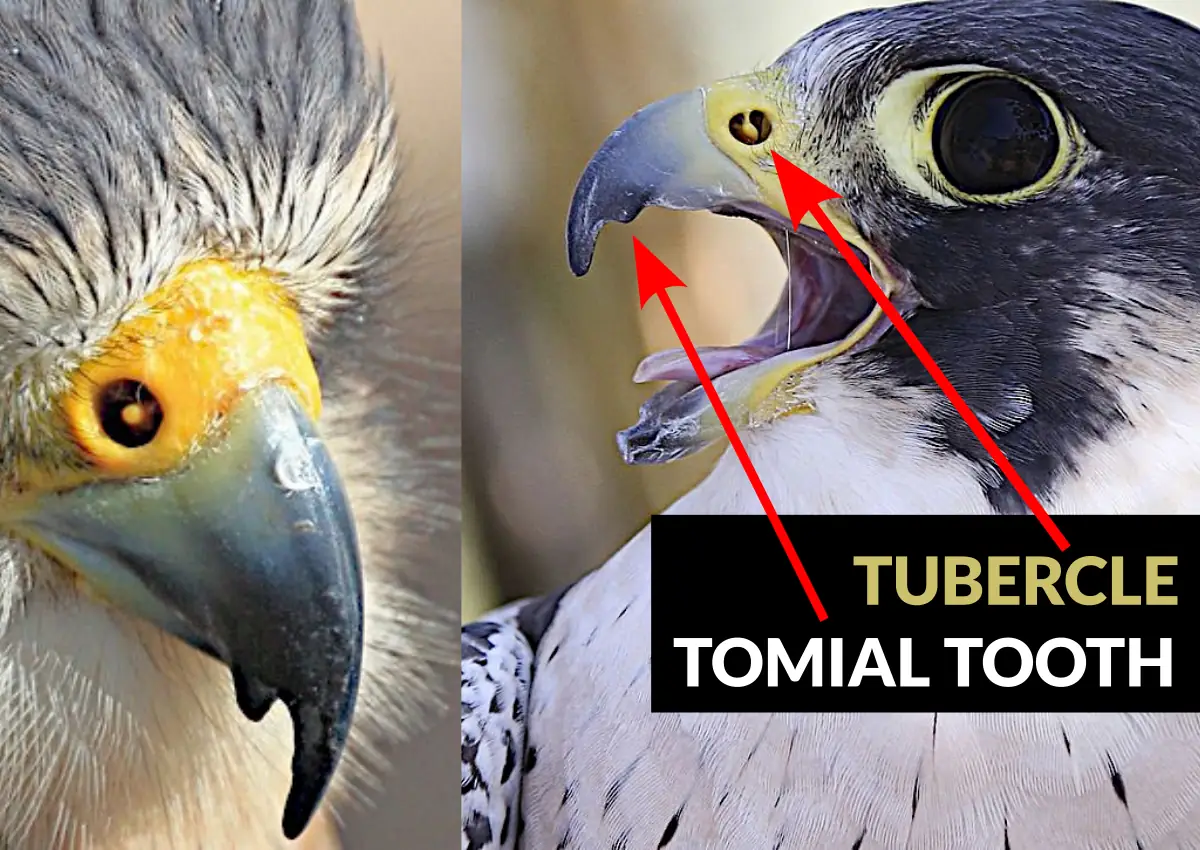
Protective Tissues: To survive the environmental stress of the dive itself, they have bony tubercles in their nostrils. These act as baffles to regulate airflow, preventing high-pressure air from damaging its lungs.
The Tomial Tooth: The peregrine falcon has a special triangular structure on its upper beak that helps it to kill its prey (usually birds). If the prey does not die upon impact, the bird uses the tomial tooth to snap the spinal cord.
How Atheistic Biology Deals With Obvious “Design”
There are two words that are used when scientists or scholars have to deal with objects that are obviously designed. These are: teleology and teleonomy.
TELEOLOGY is the idea that everything that exists has a purpose or goal. (“Things happen for a reason or for a specific goal.” ) Teleology assumes that something is best understood by looking at its intended purposes or outcome rather than just its causes or mechanism. The key question is “Why does it exist?” or “What is it for?”—not “how did it come to be?” or “How does it work?” Teleology assumes that there is a designer behind natural systems and living things.
For example, in biology, the wings of a bird were designed with the express purpose of enabling a bird to fly. Bees were designed for the purpose of pollinating plants, which in turn leads to plant fertility, reproduction, and food production that sustains ecosystems.
If God designed a thing or a creature to do something, it’s best if it does that very thing. The ultimate purpose or end of everything is the glory of God.
TELEONOMY: The term teleonomy was coined in 1958 specifically to allow atheistic biologists to describe systems that appear to be designed for a purpose without acknowledging the designer or his role.
When an evolutionary biologist looks at the bony tubercles in their nostrils of a peregine falcon he sees purpose, design, and high-level engineering. He will look at it in a teleonomic way. That is, instead of acknowledging the Master Designer, the evolutionist turns around and says, “This design is not the result of a blueprint; it emerged through a blind process of step-by-step mutation and survival over millions of years.
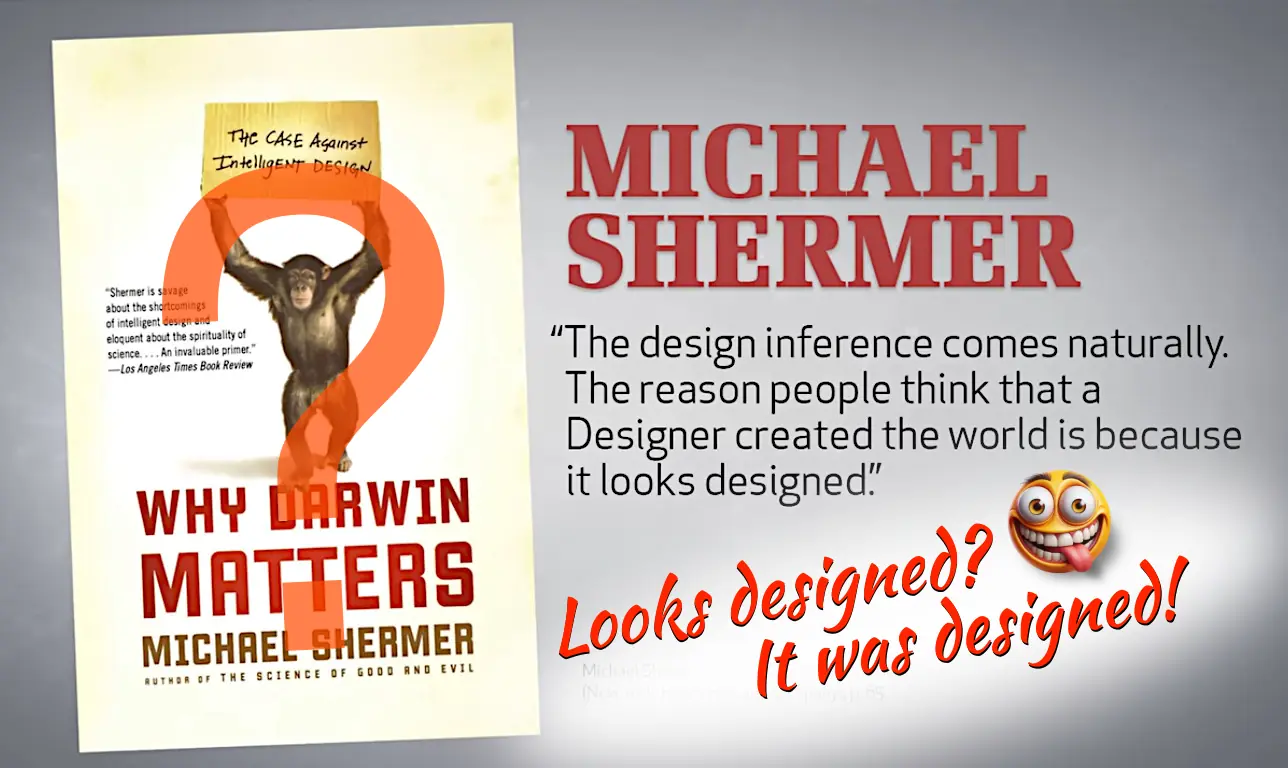
In other words, biologists have reached a stage where they are unable to deny to DESIGN and PURPOSE in living organisms. But they are unwilling to:
- acknowledge the Creator
- give glory to the Grand Designer
- submit to the authority of the Designer
Modern atheistic/naturalistic scientists thus fulfill these words in the Bible:
For the wrath of God is revealed from heaven against all ungodliness and unrighteousness of people who suppress the truth by their unrighteousness, because what can be known about God is plain to them, because God has made it plain to them.
For since the creation of the world his invisible attributes - his eternal power and divine nature - have been clearly seen, because they are understood through what has been made. So people are without excuse.
For although they knew God, they did not glorify him as God or give him thanks, but they became futile in their thoughts and their senseless hearts were darkened.
Although they claimed to be wise, they became fools … The Apostle Paul in his letter to the Roman church, 1:18-22 NET.
THE CASE OF PERFECT, COMPLEX ORGANS
Soon after his discussion on the difficulties posed by peculiar animals, Darwin talks about the problems raised by organs that are way too perfect, such as the human eye.
The human eye is a brilliantly designed organ that is made of 40 individual sub-systems. These include the iris, pupil, retina, cornea, lens, and optic nerve. It outperforms the best man-made cameras (like high-end mirror-less models such as the Sony A1 or Canon R5) in adaptability, processing, and efficiency, though cameras excel in raw specs like uniform resolution.
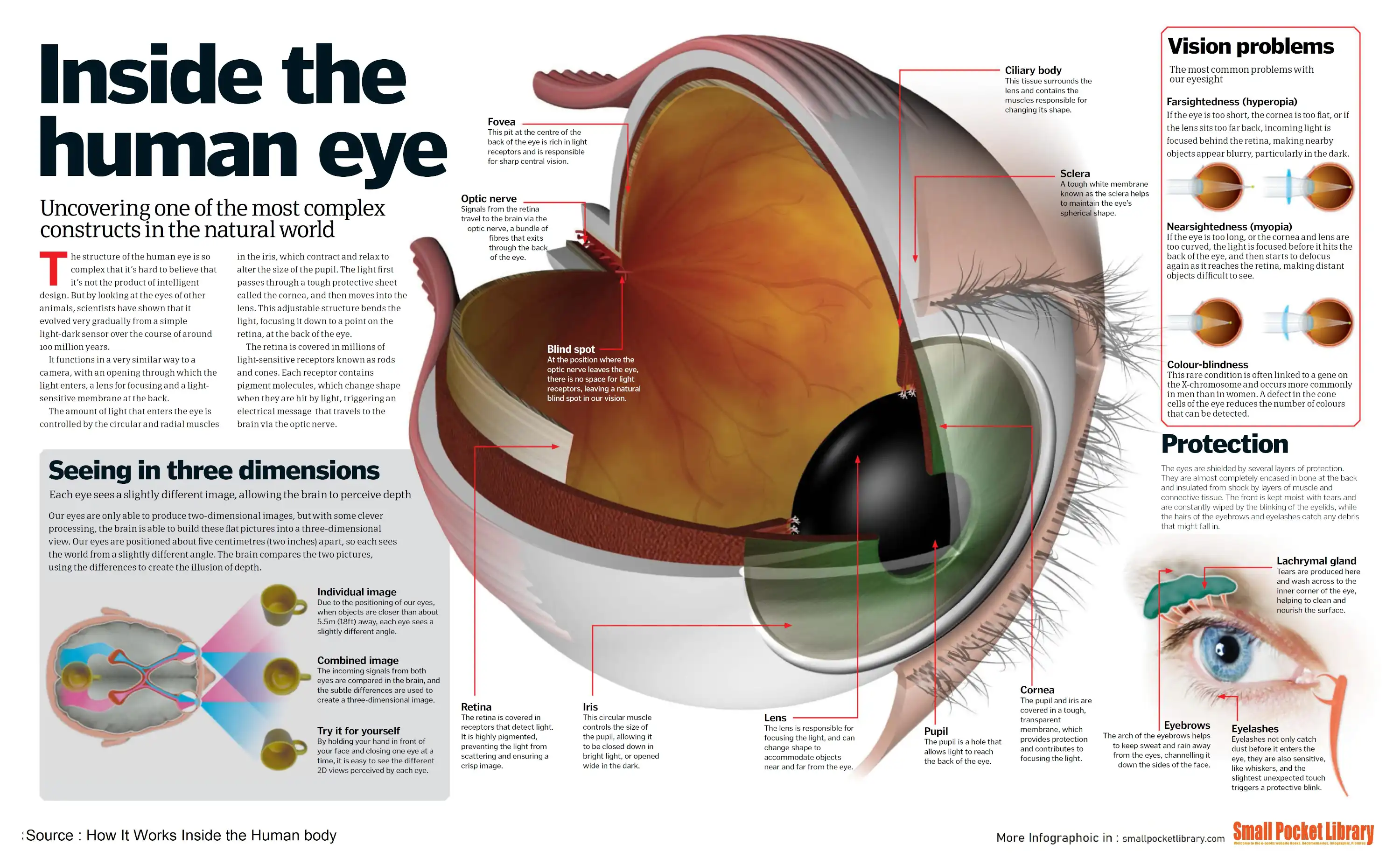
- FOCUSING MECHANISM: Our eyes use a flexible crystalline lens that changes shape instantly via ciliary muscles for near-to-far focus (accommodation); camera relies on mechanical auto-focus motors.
- LIGHT ADJUSTMENT (aperture): Eye’s iris dynamically resizes pupil from 2mm (bright light) to 8mm (dark) in milliseconds; top cameras use iris diaphragms (f/1.4–f/22) but require lens swaps or settings changes, lacking real-time fluidity.
- DYNAMIC RANGE and LOW-LIGHT ADAPTATION: Eye handles 10–24 f-stops via pupil, retinal chemistry, and dark adaptation (up to 30 minutes); cameras max ~15 f-stops natively, needing HDR stacking or high ISO (with noise); eye fills details in shadows/highlights effortlessly.
- RESOLUTION: Eye equates to ~576 megapixels at central fovea (ultra-sharp detail), but tapers peripherally; cameras offer 40–100MP uniformly across sensors.
- COLOR PERCEPTION: Eye discerns ~10 million colors via three cone types (RGB) with nuanced gradients.
- FRAME RATE AND MOTION: Eye perceives 30–60 fps with brain filling gaps and predicting motion.
- FIELD OF VIEW: Eye’s binocular 120–200° (40–60° sharp center) mimics ultra-wide lenses.
- DEPTH PERCEPTION: Eye creates true 3D via binocular disparity; cameras capture flat 2D, needing computational tricks like stereo or AI. Eye unmatched.
- PROCESSING AND NO BLIND SPOT: Eye’s brain integrates data instantly, auto-filling blind spot (optic nerve exit)
- ENERGY AND DURABILITY: Eye runs on ~20W (body’s glucose), self-repairs, self-lubricates, is infection-resistant;
Darwin did not know about the complexity of the human eye as much as we know today. Yet, he frankly admits that it ridiculous to claim that a perfect organ such as the human eye could have formed through a lengthy set of unguided, random processes.
“To suppose that the eye with all its inimitable contrivances for adjusting the focus to different distances, for admitting different amounts of light, and for the correction of spherical and chromatic aberration, could have been formed by natural selection, seems, I freely confess, absurd in the highest degree.”Charles Darwin, The Origin Of Species, p. 181.
After that, he made a fool of himself by building an unscientific and illogical argument to prove that the human eye could have been formed through “natural selection” and “survival of the fittest.”Charles Darwin, The Origin Of Species, p. 181-185.
Charles Darwin addresses the apparent absurdity of claiming that the complex human eye, with its intricate mechanisms for focus adjustment, light regulation, and aberration correction, could arise through natural selection. He concedes the initial intuition feels ridiculous, likening it to historical resistance against heliocentrism, and dismisses “vox populi, vox Dei” (the voice of the people is the voice of God) as unreliable in science. However, reason prevails: if gradations from simple to complex eyes exist across species—each stage useful, variable, heritable, and advantageous under changing conditions—the imaginative hurdle should not undermine the theory. The origin of light sensitivity in nerves mirrors life’s unexplained beginnings, as even nerve-less organisms detect light, potentially evolving from aggregated sensitive cells.
Darwin urges examining lineal ancestors, but lacking fossils, we infer from collateral species. He outlines eye evolution: starting from pigment-cell aggregates on sarcodic tissue (no nerves, just light/dark distinction), progressing to optic nerves with translucent coverings, then depressions filled with gelatinous matter for ray concentration (as in starfish), enabling crude imaging. In Articulata (e.g., insects), eyes diversify from pigment-coated nerves to multifaceted compound lenses. Given extinct species' vast numbers and observed gradations, natural selection plausibly refines these into perfect instruments, like those in Articulata.
Extending this, unexplained facts elsewhere support the theory, justifying belief in eagle-eye formation despite unknown transitions. Objections about simultaneous changes fail, as slight, gradual modifications suffice—via curvature, density, or added features like iris contraction (per Wallace). Vertebrate eyes range from lancelet’s pigmented skin sac to fish/reptile dioptric gradations; even human embryonic lenses form from skin folds. Reason must override imagination.
Finally, comparing the eye to a telescope invites caution against presuming divine intellect mimics human design. Instead, envision gradual tissue changes in density and form, with natural selection vigilantly preserving image-enhancing variations, multiplying them across millions of years and individuals—yielding a living eye superior to glass ones.
I shall read out the logical errors that are present in his argument.
- BEGGING THE QUESTION on gradations and utility (Assuming what it’s trying to prove (circular reasoning): Darwin says there are “numerous gradations” (step-by-step changes) from simple to complex eyes, and each step was useful, “as is certainly the case.” But he assumes this is true to support his theory, without showing clear proof that examples like starfish eyes really lead one to the next.
- UNWARRANTED CERTAINTY in inheritance and variation (Claiming things are certain without evidence): He states eyes “always vary and variations are inherited, as is certainly the case.” This sounds confident, but there’s no specific proof for eye changes being passed down in the animals he mentions.
- APPEAL TO IGNORANCE on origins (Dodging hard questions): He compares the mystery of how nerves sense light to how life began, saying it “hardly concerns us.” Then he guesses nerves came from simple cells in tiny organisms—but that’s just a hunch, not evidence.
- FALSE ANALOGY AND OVERGENERALIZATION from current species (Overstretching examples from living animals): He uses eyes from different species today (like insects and fish) to guess what ancient ancestors had. But today’s animals might not show a straight “ladder” of change; they could be separate designs.
- ARGUMENTUM AD MAGNITUDINEM (Relying on huge numbers to seem convincing): He stresses “millions of years” and “millions of animals” to say evolution is easy. But big numbers don’t prove random changes could build something as tricky as an eye.
- PERSONIFICATION OF NATURAL SELECTION (Making “natural selection” sound smart like a person): He describes it as “watching,” “preserving,“ and “picking” the best changes with “unerring skill.” This makes a blind process sound clever and planned, which tricks the reader.
- NON-SEQUITUR ON SIMULTANEOUS CHANGES (Skipping over tough problems): Critics say eyes need many parts working together at once. Darwin says small changes are enough (like in bred animals), but he doesn’t prove this works for eyes specifically.
IRREDUCIBLE COMPLEXITY
The human eye, or for that matter, the eyes of a hawk or a honey bee, are prime examples of organs that display IRREDUCIBLE COMPLEXITY. Another commonly cited example is that of a bacterial flagellum, a highly complex propulsion device that some bacteria possess. These complex organs cannot evolve stage by stage over many generations. They require all their components all at once. In other words, it is not possible for these organs to be created over millions of years through gradual improvements.
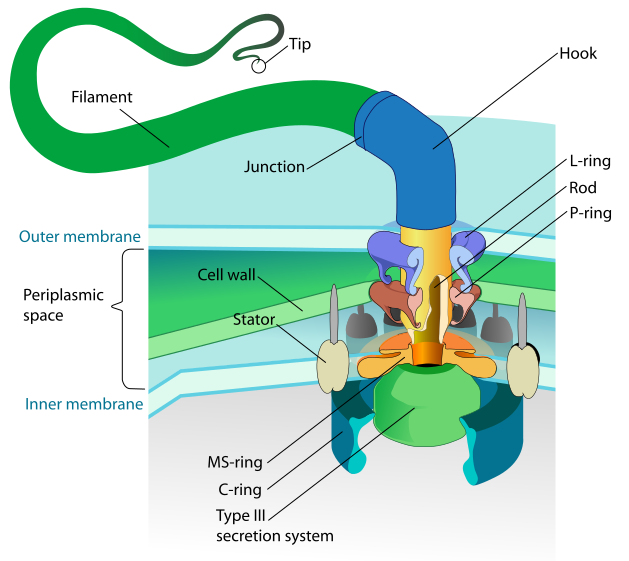
The bacterial flagellum is a huge protein machinery for bacterial movement. It propels bacteria through liquid environments at speeds up to 100 body lengths per second. It is composed of about 30 different proteins, including structural and regulatory components. The flagellum consists of three distinct parts: a rotary motor which generates power, a drive train (made of a rod and a hook), a universal joint, and a helical propeller. All these parts are assembly in an irreversible way. That is, no one can disassemble the parts and put them together. This kind of construction enables high speed propulsion at near-100% efficiency.
It is not possible for such a complex machinery to get assembled through minute changes over thousands of generations during millions of years.
To Darwin’s credit, he said that his theory would break down if someone could demonstrate that a complex organ could not have formed through a lengthy process of slow changes over many millions of years.
“If it could be demonstrated that any complex organ existed which could not possibly have been formed by numerous successive slight modifications, my theory would absolutely break down.” – Charles DarwinCharles Darwin, The Origin Of Species, p. 185.
In spite of all these logical fallacies in Darwin’s theory, atheists like Richard Dawkins swallow it. Instead of acknowledging the brilliant design of the human eye, Dawkins ridicules its design. He thinks that a squid’s eye is better than a human eye.Dawkins claims that the problem is that “light, instead of being granted an unrestricted passage to the photocells, has to pass through a forest of connecting wires, presumably suffering at least some attenuation and distortion.” Dawkins, R., The Blind Watchmaker, W. W. Norton, New York, 1986.
3. THE PROBLEM OF COMPLEX INSTINCTS
Have you heard of the Traveling Salesman Problem?
What is the Traveling Salesman Problem?

Imagine planning the shortest route to visit several cities and return home without repeats. For 1 destination, there’s just 1 route—easy. But scale up: 10 destinations explode into 300,000 possible paths. At 15 destinations, you're juggling 87 billion combinations! Even today’s fastest computers take hours or days crunching numbers for just 20-30 stops. Real-world uses include delivery trucks or circuit boards—big efficiency wins if solved perfectly.
The Traveling Salesman Problem stumps even supercomputers, yet a tiny insect solves it effortlessly every day—showing nature’s built-in genius that blind evolution struggles to explain.
Is it any wonder that Job asked his friends:
“But ask the beasts, and they will teach you;
the birds of the heavens, and they will tell you;
or the bushes of the earth, and they will teach you;
and the fish of the sea will declare to you.
Who among all these does not know
that the hand of the Lord has done this?
In his hand is the life of every living thing
and the breath of all mankind.Job 12:7-9 ESV.
The Insect That Masters TSP? The Honey Bee!
Honey bees tackle hundreds of flowers daily as “destinations,” sipping nectar while burning minimal energy. By pure instinct, they map the shortest loop connecting all spots and buzz home. No apps, no GPS—just brainpower a millionth the size of yours (human brain: ~86 billion neurons; bee: ~1 million). The bees behaviour matches top computer algorithms, but bees do it in seconds, mid-flight, amid wind and obstacles. Scientists confirm bees use a mental “waggle dance” to share routes and compute optimal paths on the fly.
Bees’ Jaw-Dropping Flight Skills
Bees lack compasses, gyroscopes, speedometers, or autopilot. Yet they nail hundreds of landings daily. Think of it. Bees land on flowers bobbing every which way in the wind. Imagine approaching a shaking target. Can a helicopter pilot land safely on skyscraper helipad that’s moving like a flower in the wind? Even with the help of radars, the risk of crashing is very high.
What about honey bees? They execute their landings flawlessly, every time. They automatically adjust their speed, position, and angle so that their touchdown is at near-zero speed relative to the movement of the flower. That’s like parking a bike perfectly on a seesaw. Tests show that they sense air flow, flower sway through their powerful vision and by sensing even electric fields from nectar.
Evolutionists Are Puzzled
Smart humans with trillion-dollar technology can’t match the feat of bees instinctively. Yet evolutionists claim bees arose 300+ million years ago via random mutations—no guide, no goal, no intelligence. How did unguided trial-and-error build such precision navigation and flight control from simple cells? One wrong instinct tweak, and the colony starves. Bees scream “designed brilliance,” not blind chance. What do you think powered this?
Darwin Could Not Explain Bee-Behaviour
It’s not as if Darwin was ignorant about the complexity of a honey bee’s behavior. He knew that bees behaved by instinct. But he could not explain the evolution of instincts. While describing the difficulties his theory faced, Darwin asked,
“Thirdly, can instincts be acquired and modified through natural selection? What shall we say to the instinct which leads the bee to make cells, and which has practically anticipated the discoveries of profound mathematicians?”Charles Darwin, The Origin Of Species, p. 169.
4. THE PROBLEM OF INTER-SPECIES BREEDING
Fourthly, Darwin identifies another difficulty with his theory: Why can’t we force individuals of different species to breed? Even if we succeed in crossing individuals of two different species, why does the offspring become sterile or infertile? When individuals of the same species reproduce, the fertility of their offspring is not affected.
Male Lion x Female tiger = liger (male infertile; female might be fertile)
Male Tiger x Female Lion = tigon (male infertile; female might be fertile)
Male Donkey x Female Horse = mule (male infertile; female might be fertile)
Male Horse x Female Donkey = Hinny
Infertility Cause: Genetic incompatibility and mismatched chromosome pairs prevent proper cell division (meiosis) needed for viable sperm or eggs, especially in males.
B. HELIUM: A WITNESS AGAINST “MILLIONS OF YEARS”
I had already mentioned that materialistic atheists believe in Uniformitarianism. It is the belief that the natural laws and processes we observe today have operated in the same way, and at the same speed, throughout all of time and space. That is, they do not account for sudden, catastrophic changes.
As a result, modern science assumes that radioactive decay rates—the speed at which uranium atoms break down into lead while releasing helium gas—are fixed “constants” that never change.
Key Assumption Explained
Scientists start with this big idea: If we measure how fast uranium decays today (using lab tools), we assume it decayed at exactly the same speed billions of years ago. We can’t time-travel to check, so this is like a belief they build everything on. Without it, their dating methods fall apart.
What It Leads To
If decay rates stayed constant, the mix of lead and uranium in certain tough crystals (called zircons) tells us how old the rock is. More lead means more time passed—often millions or billions of years. Helium bubbles form as a byproduct (alpha particles from decay get trapped).
The Helium Problem
Here’s the catch: Helium is a gas that easily leaks out of zircon crystals over time, like air escaping a balloon. For rocks dated at 1.5 billion years (by lead ratios), all helium should have escaped long ago. But tests show lots of helium still trapped inside—way more than expected. This points to the rocks being much younger, around 6,000 to 10,000 years old, not billions. It’s a direct clash with old-earth dates.
Why It’s Ignored
Instead of rethinking old-earth timelines based on helium evidence, many scientists call it a “weird anomaly” and stick to their uranium-lead clocks. This protects their long-age views rather than fixing the contradiction. They argue that:
- Diffusion is complex: They suggest Helium doesn’t leak as fast as previously thought under certain pressures or temperatures.
- External Sources: They might suggest Helium from surrounding rocks “leaked into” the zircons rather than being produced inside them.
- Experimental Error: They may claim the laboratory measurements of Helium diffusion are flawed.
There’s Not Enough Time For Evolution
True science says, The Earth is not more than 6000 to 10,000 years old. This is too short a time period for “evolution” to happen. Darwin’s theory of natural selection over “millions of years” does not hold much water.
C. THE FINE-TUNED UNIVERSE
The planet earth is the only place in the known universe where life exists. Why is life not found on any other planet or galaxy? Biology, by itself, cannot explain this because the factors that make life possible on earth has to do with physics and chemistry.
In 1913, it was Lawrence Henderson, a chemist, who first highlighted the importance of specific conditions on earth that support life. He wrote about the need for water and the special properties of water that sustains life.
- Polarity of Water Molecules: Each molecule has a part that is positively charged and a part that is negatively charged. This property is beneficial to life in many ways.
- SURFACE TENSION: The positive and negative parts of water molecules help each molecule to stick to another molecule. This is why water molecules on the surface hold tight to each other, forming a tight skin of water molecules. This is called surface tension. Surface tension causes water to clump in drops rather than spread out into a thin layer. This cohesive tendency of water molecules allows water to move through plant roots and stems, and the smallest blood vessels in the body. As one molecule moves up, it ‘pulls’ the others with it.
- EXCELLENT SOLVENT: The charged parts of the water molecule attract and hold other charged molecules. For example, when a polar substance such as salt is added to water, the positively charged Sodium atoms (ions) gets attracted to the negatively charged part of water. The negatively charged Chloride atoms (ions) get attracted to the positively charged hydrogen atoms in water. The polarity of water molecules makes water a universal solvent. Water dissolves more substances than any other liquid. This is why water is often called the ‘universal solvent.’ The ability of water to dissolve polar substances is very important for life on Earth. Wherever water goes, it carries dissolved chemicals, minerals, and nutrients that are used to support living things.
- IN THREE STATES: Water is the only natural substance that can exist in all three states of matter – solid, liquid, and gas – at temperatures normally found on the Earth’s biosphere (the thin layer of earth’s crust that sustains life). Liquid water is found in streams, ponds, wells, etc. Gaseous water is found in the atmosphere. Solid water (ice) is found in higher altitudes and higher latitudes.
Water has a unique property that preserves aquatic life. Water contracts on cooling till it reaches 4 degree Celsius. If we cool water below 4C, it expands rapidly to form ice that is less denser than water. If you examine a frozen lake, you will notice that the heaviest water at 4 degrees is right at the bottom. Ice at zero degree Celsius floats at the top. Warmer water stays in between. The ice on top prevents the freezing of water below it. Living creatures can survive in the liquid water below the ice layer. - HIGH SPECIFIC HEAT: Water has high specific heat. That is, it takes more heat to increase the temperature of water by one degree. Similarly, it takes more heat loss to decrease the temperature of water by one degree. In other words, the temperature of water remains more stable than the temperature of land and atmosphere. This is good for aquatic life forms. Besides, large bodies of water prevent extreme temperatures in coastal regions.
- HIGH HEAT OF VAPORIZATION: It takes a lot of heat to convert liquid water to its vapour state. That is, if water evaporates from any surface, it absorbs a lot of heat from that surface. Due to this property of water, sweating helps to cool our body.
In 1961, physicist Robert H. Dicke argued that certain forces in physics, such as gravity and electromagnetism, must be perfectly fine-tuned for life to exist in the universe. R. H. Dicke (1961), “Dirac's Cosmology and Mach’s Principle”, Nature. 192 (4801): 440–41. doi:10.1038/192440a0. S2CID 4196678.
In 1981, Fred Holyle, an astronomer, made a remarkable statement:
A common sense interpretation of the facts suggests that a super intellect has monkeyed with physics, as well as with chemistry and biology, and that there are no blind forces worth speaking about in nature.Fred Hoyle, The Universe: Past and Present Reflections, Cardiff: Department of Applied Mathematics and Astronomy, University College, 1981.
In 1983, he wrote in his book The Intelligent Universe,
“The list of anthropic properties, apparent accidents of a non-biological nature without which carbon-based and hence human life could not exist, is large and impressive.“Fred Hoyle, The Intelligent Universe, London: Michael Joseph Ltd, 1983. (“Anthropic properties” (or the anthropic principle) refer to the remarkably precise, “fine-tuned” fundamental physical constants and cosmological conditions of the universe that enable the existence of intelligent life)
Here is a list of some physical constants that appear to be set to facilitate life on earth. Even if a small change is made in any of these parameters, life would become impossible.
FUNDAMENTAL FORCE CONSTANTS
Gravitational force constant (G): Holds planets and stars together. Slightly stronger? Stars burn too fast, no long-lived planets. Weaker? Stars and galaxies never form.
Electromagnetic force constant: Glues atoms (electrons to nuclei). Stronger/weaker? No stable molecules or chemistry for life.
Strong nuclear force constant: Binds protons/neutrons in atomic cores. 2% stronger? Too much hydrogen fuses to helium, no water or carbon. 0.5% weaker? No heavy elements beyond hydrogen.
Weak nuclear force constant: Controls radioactivity and fusion. Slightly off? No heavy elements like carbon/oxygen; stars explode or fizzle.
PARTICLE PROPERTIES
Ratio of proton to electron mass (1836:1): Proton much heavier keeps atoms stable. Slightly different? DNA/RNA building blocks impossible.
Neutron-proton mass excess: Neutron slightly heavier enables fusion. Greater? Too few heavy elements. Smaller? Stars collapse to black holes early.
Cosmological constant (Λ): Drives universe expansion. 1 part in 10 off? Positive tweak: universe flies apart, no galaxies. Negative: will cause stars and planets to go nearer.
OTHER KEY NUMBERS
Speed of light (c): Caps all speeds. Faster? Stars too bright/hot. Slower? Stars too dim/cold.
Initial mass-energy distribution: Universe's starting setup. Off? No galaxies, stars, or planets.
Entropy level of early universe: Measures disorder. Higher? No stars/galaxies form.
These aren't random—they proclaim aloud that the universe was designed by a Master Designer! A small change anywhere will result in chaos and destruction.
D. INFORMATION IN DNA
The discovery of the structure of DNA molecule in 1953 raised one of the greatest challenges for naturalistic science based on Darwinism or neo-Darwinism.
DNA stands for Deoxyribo nucleic acid. A DNA is a long double-strand that resembles a double helix. It is present in the nucleus of every living cell. It contains information about each and every characteristic of the whole organism. Every information about a creature – from the color of its eyes to the shape of its ears — is recorded in the DNA that is present in every cell. The information is used to create protein molecules.
The information in a DNA strand is recorded using four chemicals (bases). These four chemicals are Adenine, Cytosine, Thymine, and Guanine. They are represented by their first letters A, C, T, and G. They form specific pairs: Adenine (A) always pairs with Thymine (T), and Cytosine (C) always pairs with Guanine (G). These chemicals are arranged in a double-helix structure. They form nucleotides, which in turn forms the DNA.
The order in which these four letters (A, T, C, G) are arranged is very important. That order contains instructions for building and operating every part of a living organism. This is why it is called the Genetic Code or The Language of Life. This is just like we use twenty-six letters of English alphabet to create sentences, paragraphs, stories, essay, and books. The arrangement of letters creates words with meanings. In the same way, the arrangement of A, C, T, and G contains information about ALL parts of that living creature.
The sheer volume of information contained within the DNA is astonishing. It is the most densely packed information system in the whole universe.
Geneticist Michael Denton, a molecular biologist and geneticist, used an analogy to illustrate the high density of information in DNA.
”The capacity of DNA to store information vastly exceeds that of any other known system; it is so efficient that all the information needed to specify an organism as complex as man weighs less than a few thousand millionths of a gram. The information necessary to specify the design of all the species of organisms which have ever existed on the planet … could be held in a teaspoon and there would still be room left for all the information in every book ever written.”Michael Denton, Evolution: A Theory in Crisis, Bethesda, MA: Adler & Adler, 1985. p. 334.
THE MECHANISM OF PROTEIN SYNTHESIS
One of the most fascinating processes that take place in the human body is the synthesis of protein molecules using information stored in the DNA. Protein synthesis happens inside a living cell. Part of the process takes place inside the nucleus because that’s where the DNA is. The other half of the process takes place outside the nucleus
Imagine protein synthesis like making perfect duplicate keys for a master lock system inside a cell.
Your DNA is the master key blueprint—a long, twisted ladder of coded instructions locked in the cell’s nucleus. To build a protein (like a functional key), the cell first makes a working copy of just the right section. This is transcription: enzymes unzip the DNA ladder at a specific spot, read one strand, and use it as a template to craft a single-stranded messenger RNA (mRNA) copy—like photocopying a key pattern onto a thin metal blank. The mRNA slips out of the nucleus, carrying the code to the factory floor.
Next comes translation at the ribosome, a tiny workbench outside the nucleus. The mRNA unrolls like a strip of key notches (codons—groups of three letters spelling amino acid types). Transfer RNA (tRNA) molecules act as picky delivery trucks: each grabs a specific amino acid “bead” from the cell’s supply, matching its anticodon tag to the mRNA’s codon—like a truck only fitting one notch in the key blank. The ribosome slides along the mRNA, snapping beads together into a chain. One by one, peptide bonds lock them tight, forming a growing polypeptide string—your duplicate key taking shape.
Finally, the chain folds into a 3D protein key, ready to unlock jobs like fighting germs or speeding reactions. Errors? Rare, but they make faulty keys. This assembly line churns out proteins non-stop, building life’s machinery.
There are several questions evolutionists must answer.
- If the universe consists of just matter and energy, where did all this information come from?
- If information is a sure sign of intelligence, how long will you deny that life on earth is a product of random, purposeless happenings? If there is an explosion in a printing press, will that result in the production of a dictionary?
- If information required for the synthesis of protein molecules is stored in the DNA of a living cell, how was the first protein molecule synthesized when there was no living beings on earth?
E. ABIOGENESIS IS NOT POSSIBLE
Abiogenesis refers to the claim that the first living organism, a unicellular life form, was spontaneously generated from inorganic matter as a result of random, undirected processes.
In the early 20th century, some scientists proposed that life’s chemistry could have begun in a “primordial soup”—Earth’s early oceans allegedly enriched with simple compounds that, given enough time and energy, might form more complex organic molecules. This idea is commonly associated with Aleksandr Oparin and J.B.S. Haldane, who suggested that a reducing early atmosphere (low in free oxygen) plus energy sources like lightning or sunlight could drive chemical reactions that gradually built up organic building blocks in the sea.
The most famous laboratory attempt to model this was the 1952–1953 Miller–Urey experiment at the University of Chicago, carried out by Stanley Miller under Harold Urey’s supervision. They built an enclosed glass apparatus meant to mimic an “ocean” and an “atmosphere” in a continuous cycle. In the classic setup, a lower flask contained water that was heated to boiling so water vapor would circulate upward, and an upper chamber contained a mixture of gases that were then energized by electrical sparks to simulate lightning. Specifically, the original experiment sealed methane (CH₄), ammonia (NH₃), and hydrogen (H₂) together (reported as a 2:2:1 ratio) with water (H₂O), used a continuous spark discharge between electrodes, and included a condenser so products could cool and collect in a trap for sampling. The system was run for about a week, during which the trapped liquid changed color and became visibly “brothy,” indicating that new chemicals were forming.
When Miller analyzed the collected solution using paper chromatography, he reported several amino acids—small organic molecules that are building blocks of proteins—such as glycine and alanine. Later re-analyses of archived samples using modern methods found that the experiment produced more amino acids than originally reported. In that limited sense, the experiment did succeed at producing some organic molecules from simple starting materials plus energy input.
However, it is also important to state clearly what the experiment did not demonstrate. The classic Miller–Urey work did not synthesize a protein molecule (a folded chain of amino acids with specific sequence and function), but rather small organic “monomers” like amino acids. No biological macromolecules were created.
Critics of “primordial soup” storytelling often point out a deeper philosophical issue: the role of the scientists is essential and cannot be erased from the narrative. In the experiment, intelligent agents selected gases, sterilized and sealed glassware, controlled heat, maintained a stable one-week run, prevented contamination, and used sophisticated methods to detect and interpret products. So while the experiment is presented as “abiogenic” chemistry (organic molecules from inorganic precursors), it is not an example of life emerging “without any external intelligence at work” in the sense of an unguided natural setting; it is a carefully designed and interpreted laboratory protocol.
Finally, there is a significant gap between forming amino acids and forming proteins in a lifelike way.
Scientists who limit their theories to naturalistic explanations must understand this truth: Life is not natural. It is supernatural. Life originates in God. It is a gift of God. Only God can impart life or create life. Therefore, human science, with its atheistic presuppositions, cannot explain the origin of life.
Further Reading
- Michael Behe, Darwin Devolves.
- Stephen C. Meyer, Darwin's Doubts.
- Stephen C. Meyer, Return of the God Hypothesis.
- Carl Werner, Evolution: The Grand Experiment.
- Jonathan Surfati. By Design.
- Ray Comfort. Nothing Created Everything.
- Ray Comfort. Made In Heaven.