Against Arianism
“God is One. How can you say Jesus is ‘God’?”
“Wasn’t Jesus just the son of God and a created being?”
Can you answer such questions Unitarians and Arians ask?
Outline
- Introduction
- Q1: How Can A Visible Jesus Be God?
- Q2: Wasn’t Jesus merely “the image of God”?
- Q3: Did Jesus Exist From Eternal Past?
- Q4: Wasn’t Jesus The “Firstborn of all Creation”?
- Q5: How Many “Gods” Are There In John 1:1?
- Q6: God Is One. How Can Jesus Be Another God?
- Q7: Did Translators Get Romans 9:5 Wrong?
- Q8: Do More Verses Say Jesus Is “God”?
- Q9: Is the Triadic Formula in Matthew 28:19 authentic?
- QR Code For Sharing This Page
- Select Bibliography
Listen to a podcast based on this teaching
There are many who claim the banner of “Christianity” yet adamantly deny the absolute deity of the Lord Jesus Christ. Operating under the guise of a strict monotheism, they argue that God is an absolute, solitary individual consisting of only one Person. Consequently, they dismiss biblical concepts like “God the Son” and “God the Holy Spirit” as dangerous, unscriptural errors.
In reality, these individuals are simply the modern resurrectors of a ancient fourth-century heresy known as Arianism. Like their ideological ancestor Arius, they relegate Jesus to the status of a created being. They confidently assert that God brought Jesus into existence as His very first creature—interpreting titles like “Son of God” or “the firstborn of all creation” through a flawed, purely chronological lens.
Recently, I encountered the teachings of one such self-styled Arian teacher based in India. For the sake of this critique, we will call him Kevin. He possesses no formal theological training, nor does he consider a rigorous biblical education to be worthwhile or necessary. Yet, despite this lack of foundational equipping, he has assumed the mantle of a Bible teacher. The inevitable result? His arguments betray a profound lack of logical reasoning, a complete ignorance of historical theology, and a remarkably superficial grasp of the Scriptures. Merely pulling isolated Bible verses out of context does not make someone a competent handler of God’s Word.
While the global Church decisively exposed and defeated Arianism nearly 1,700 years ago at the Council of Nicaea, many modern believers are still easily swayed by these recycled errors. Too many Christians today suffer from a double liability: they lack a deep, systematic understanding of biblical doctrine, and they are entirely unaware of Church history and the theological battles fought over the last twenty centuries.
Kevin operates under the illusion that his unitarian arguments are invincible. This work is a direct, systematic refutation of the core challenges he raises. By dismantling these errors, my goal is to better equip everyday Christians to confidently defend the historic, orthodox faith founded upon apostolic teaching.
What follows is a compilation of the specific arguments Kevin advances, paired with clear, exegetical, and historical answers.
Q1: How Can A Visible Jesus Be God?
Kevin asks: “The Bible says that ‘no one has seen God any time.’ How can Jesus be God? Since Jesus wasn’t invisible, it is clear that Jesus wasn’t God. It is the Father who is God and no one has seen the Father.”
Answer
Pulling “no one has seen God at any time” out of its literary context entirely misses the brilliant point the Apostle John is making. Let’s look at the complete verse in John 1:18.
“No one has seen God at any time; the only-begotten God, who is in the bosom of the Father, he has explained him.” (John 1:18, NASB)
This verse is the grand climax of the Prologue to John’s Gospel. John is contrasting the ministry of Moses with the ministry of Jesus (v. 17). While Moses received the Law, he was famously denied the ability to see God face-to-face (Exodus 33:20). John’s argument is that Jesus’ revelation is far superior because Jesus is the physical manifestation of the invisible God.
Notice the precise mechanics of this verse:
1. The Greek Text Expressly Calls the Visible Jesus “God”
Unitarians (that is, those who reject the doctrine of the Trinity) often try to dodge this verse using later, inferior manuscripts that translate the phrase as “only-begotten Son.” However, the earliest and most accurate Greek papyri and uncials (P66, P75, Sinaiticus, Vaticanus) read μονογενὴς θεός (monogenēs theos)—“the unique, only-begotten God.”
As masterfully analyzed by textual scholar Bruce Metzger, John is deliberately pairing two truths in one sentence: God in His ultimate spiritual essence (the Father) cannot be seen by human eyes, but the unique God who resides in the very bosom of the Father (the Son) has physically entered human history to make Him known. Far from proving Jesus isn’t God, John 1:18 explicitly labels the visible Jesus as Theos, God.
2. The Solution to the Old Testament Paradox
The unitarian framework completely collapses when confronted with a massive Old Testament problem. The Old Testament repeatedly claims that people did see God:
- In Exodus 24:10, Moses and the elders of Israel “saw the God of Israel.”
- In Isaiah 6:1, the prophet declares, “I saw the Lord sitting upon a throne, high and lifted up.”
If “no one has seen God at any time,” who did Moses and Isaiah see? The New Testament gives us the answer. Isaiah had seen the glory of Christ! Let me explain.
John helps us understand that Isaiah saw Christ in his vision. He does this declaring that Isaiah’s words – spoken soon after he had seen the vision – predicted the way Jews would reject Jesus and his ministry.
“Although Jesus had performed so many miraculous signs before them, they still refused to believe in him, so that the word of Isaiah the prophet would be fulfilled. …
“For this reason they could not believe, because again Isaiah said,
‘He has blinded their eyes and hardened their heart, so that they would not see with their eyes and understand with their heart, and turn to me, and I would heal them.’
Isaiah said these things because he saw Christ’s glory, and spoke about him.” (John 12:37, 39-41. NET Bible)
In the Greek New Testament, it just says, “he saw his glory, and spoke about him.” Why then did the NET Bible specify that it was Christ’s glory that Isaiah saw?
John quotes the passages from Isaiah in the context of Jewish unbelief (see verse 37). That unbelief had been predicted by Isaiah, in chapter 6, soon after Isaiah had a vision of God. Therefore, when John says that Isaiah “saw his glory, and spoke about him,” we understand that Isaiah had seen Christ’s glory and had predicted about Christ. The context demands such a reading.
Now, it was not only Isaiah who saw Christ’s glory. Every single time a human being physically locked eyes with “Yahweh” in the Old Testament, they were looking at a Christophany—the pre-incarnate Word, the visible manifestation of the Godhead.
That includes Abraham, who had a visual encounter with Yahweh while he still lived in Mesopotamia. In Stephen’s words, “the God of glory” appeared to Abraham (Acts 7:2). Later, God appeared to Abraham while he travelled through Canaan (Gen 12:7). Still later, in chapter 15:4, the word of Yahweh appeared to Abraham in a vision. This “word of Yahweh” was not a formless voice. He was a person. Verse 5 says, “And he brought [Abraham] outside and said, ‘Look toward the heavens and count the stars … .’” The “Word of Yahweh” was a visible entity!
“These appearances of the Word of Yahweh are the conceptual backdrop to the apostle John’s language in his gospel that Jesus was the Word.” – Michael S. Heiser, The Unseen Realm
These revelations were not mere “appearances” or “apparitions.” Yahweh came to Abraham in a real body. Chapter 18 of Genesis, opens with this line:
And Yahweh appeared to him by the oaks of Mamre. And he was sitting in the doorway of the tent at the heat of the day. (LEB)
Abraham saw three men. They were not ghosts. They appeared in human form. Abraham offered to wash their feet and to prepare a meal for them. They received Abraham’s hospitality.
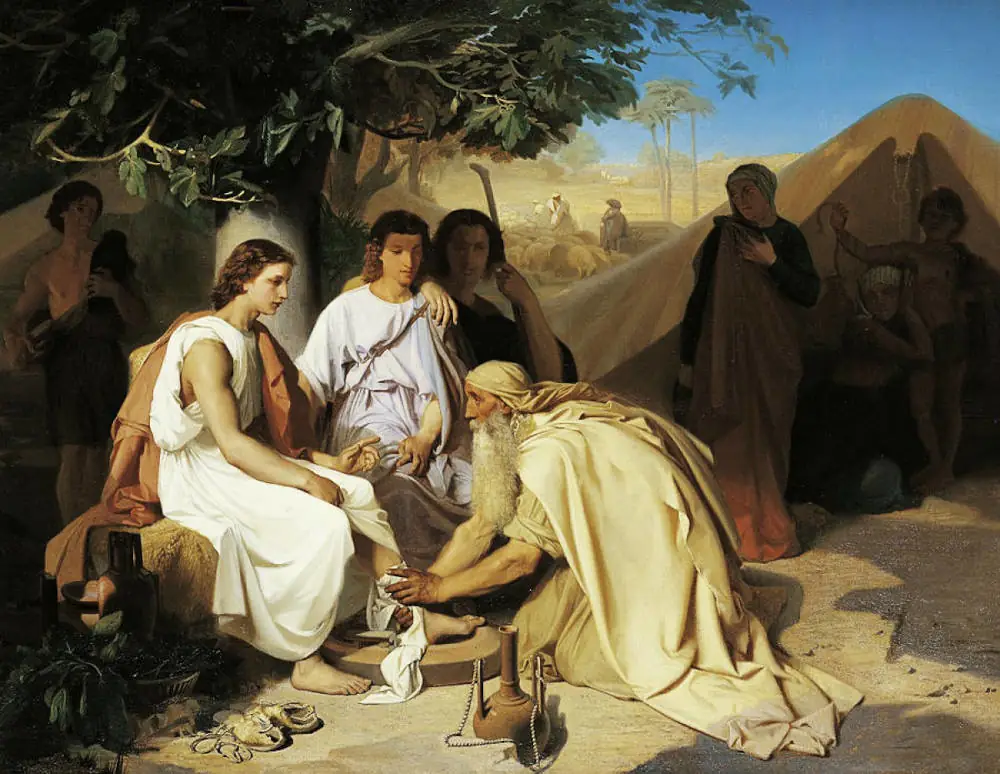
Abraham knew that one of them was Yahweh. After two of the men went down to Sodom, Yahweh stood with Abraham and revealed his plan to judge Sodom and Gomorrah. Abraham, then, petitioned Yahweh – the supreme Judge – to spare the valley on account of the righteous men living there. (Gen 18:25 LEB)
Yahweh’s appearance before Samuel is notable. From our childhood, we have heard that the word of Yahweh came to the boy Samuel. It was not a mere voice. “Then Yahweh came and stood there and called out as before, ‘Samuel! Samuel!’” (1 Sam 3:10 LEB). That was not a one-off experience. It happened again. Such revelations were the basis of Samuel’s prophetic career.
“All Israel from Dan to Beersheba realized that Samuel was faithful as a prophet to Yahweh. And Yahweh appeared again in Shiloh, for Yahweh revealed himself to Samuel in Shiloh through the word of Yahweh”. (3:20-21
Most Christians have heard the story of Jeremiah’s call to prophetic ministry. But did you know that it was the Word of Yahweh that came to him? When we read, “And the word of Yahweh came to me …” (Jer 1:4) we suppose that Jeremiah just heard a voice. But how can a mere voice do this?
Then Yahweh stretched out his hand and he touched my mouth, and Yahweh said to me, “Look, I have put my words in your mouth. …” (1:9)
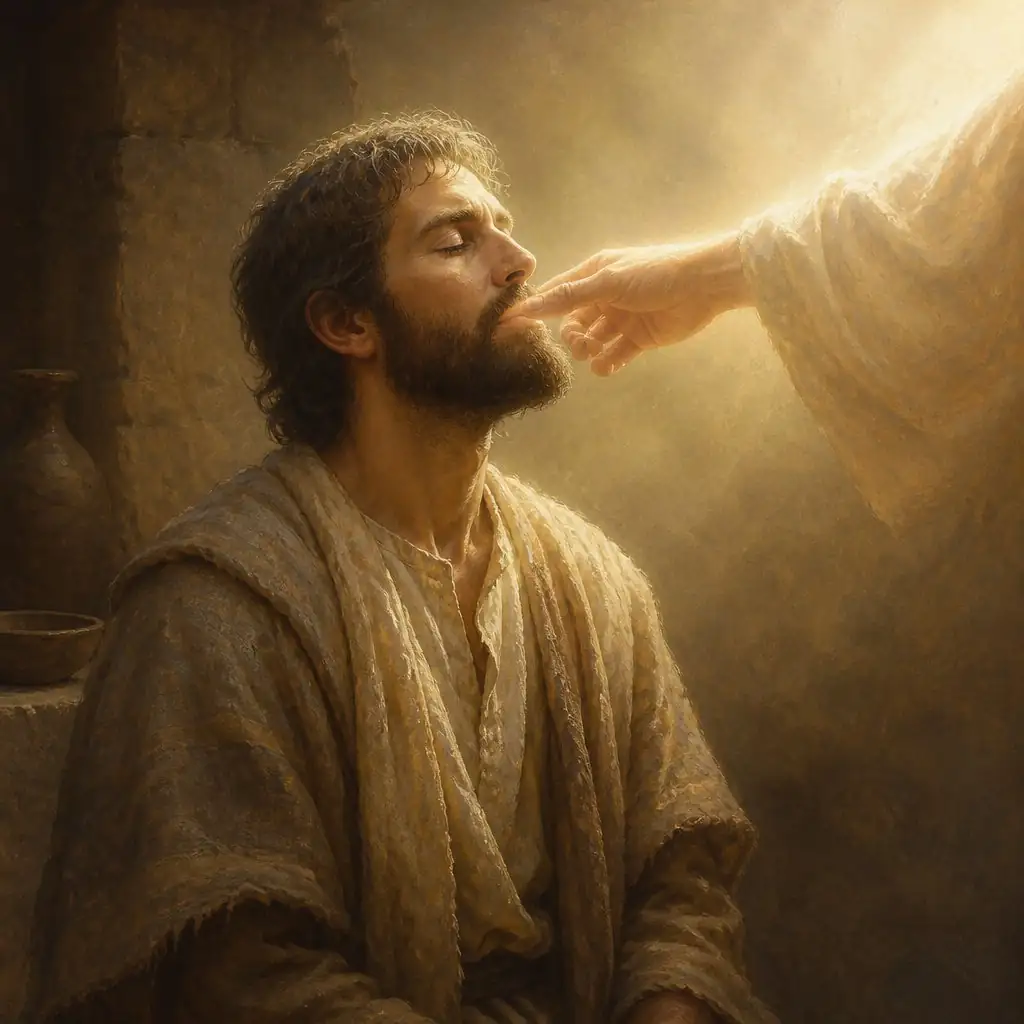
Surely, Abraham, Samuel, and Jeremiah were dealing with a person called “the Word of Yahweh.” Who was this visible expression of Yahweh – “the Word of Yahweh” – if not the pre-existent Word who later took up human flesh?
Who was this visible expression of Yahweh – “the Word of Yahweh” – if not the pre-existent Word who later took up human flesh?
3. Fully Divine, Fully Revealed
The Apostle Paul would later write, Jesus is “the image of the invisible God” (Colossians 1:15) and “in him the whole fullness of deity dwells bodily” (Colossians 2:9).
When Jesus told Philip, “He who has seen me has seen the Father” (John 14:9), He was not claiming to be an optical lens or a mere prophetic channel. He was claiming to be the ultimate, physical self-revelation of God. When Thomas looked at the risen Lord Jesus, Thomas wasn’t seeing the Father through a transparent Jesus. He was looking at the physical embodiment of God. That’s why Thomas exclaimed, “My Lord and my God!”
It was not just Thomas. Even John was overwhelmed by the thought that he had once leaned on the divine Word! When he wrote his first epistle, he wrote the opening lines with such tangible excitement:
“What was from the beginning, what we have heard, what we have seen with our eyes, what we have looked at and our hands have touched, concerning the Word of life ...” (1 John 1:1)
To say that Jesus cannot be God because He was visible is to entirely misunderstand the Incarnation. God the Father is spirit and invisible; God the Son took on flesh so that the invisible God could be heard, seen, and touched.
Q2: Wasn’t Jesus Merely “the Image of God”?
When presented with the titles of the Savior, as seen in Isaiah 9:6, Kevin says: “Jesus told his disciples that whoever has seen him has seen the Father. So, Jesus on the earth is Immanuel, ‘God with us.’ However, it does not mean that Jesus is God. Jesus is just the image and glory of God the Father. There are many verses to prove this.”
Answer
Kevin’s argument tries to turn the words “image” and “glory” into terms that mean a lesser, secondary reflection. But when we look at how the Bible actually defines these terms, his unitarian position faces an immediate, fatal contradiction based on God’s own decrees.
1. The Isaiah 42:8 vs. John 17:5 Collision
Kevin acknowledges that Jesus is the “glory of God.” But he must reckon with what Yahweh says about His glory in Isaiah 42:8:
“I am Yahweh; that is my name; my glory I give to no other ...”
God is absolutely clear: His divine glory cannot be shared with, given to, or possessed by a created being. It belongs exclusively to the uncreated Creator. Yet, in John 17:5, Jesus prays:
“And now, Father, glorify me in your own presence with the glory that I had with you before the world existed.”
If Jesus is a created being—a separate “other” from the one true God—then God sharing His pre-creation glory with Jesus directly violates Isaiah 42:8. The only way Jesus can possess the literal glory of God without making God a liar is if Jesus shares the exact same undivided divine essence as the Father.
2. He is the “Exact Imprint,” Not a Mirror Reflection
The New Testament writers use precise Greek vocabulary to prevent the very twisting of scripture you are attempting. In Hebrews 1:3, the author states that the Son is the radiance of God’s glory and the “exact imprint of his nature” (Greek: charaktēr tēs hypostaseōs).
The word charaktēr means the exact stamp of an engraving tool into metal. The Son isn’t a vague likeness; He possesses the exact stamp of the Father’s hypostasis (substance/nature). If the Father’s substance is eternal, uncreated God, then the Son’s substance must be identically eternal, uncreated God.
This is why Colossians 2:9 concludes: “For in him the whole fullness of deity dwells bodily.” He doesn’t have a percentage of God’s reflection; He has the fullness of God’s nature in physical form.
The Test of Worship
Unitarians claim there is “not much” to being the image of God. It is true that humans are made in the image of God (Gen 1:27), and Paul says man is the “image and glory of God” (1 Cor 11:7).
But notice the massive difference:
- When people fell down to worship the Apostle Peter, Peter tore his clothes and said, “Stand up; I too am a man” (Acts 10:26).
- When John fell down to worship an angel, the angel said, “You must not do that! I am a fellow servant ... Worship God” (Revelation 22:9).
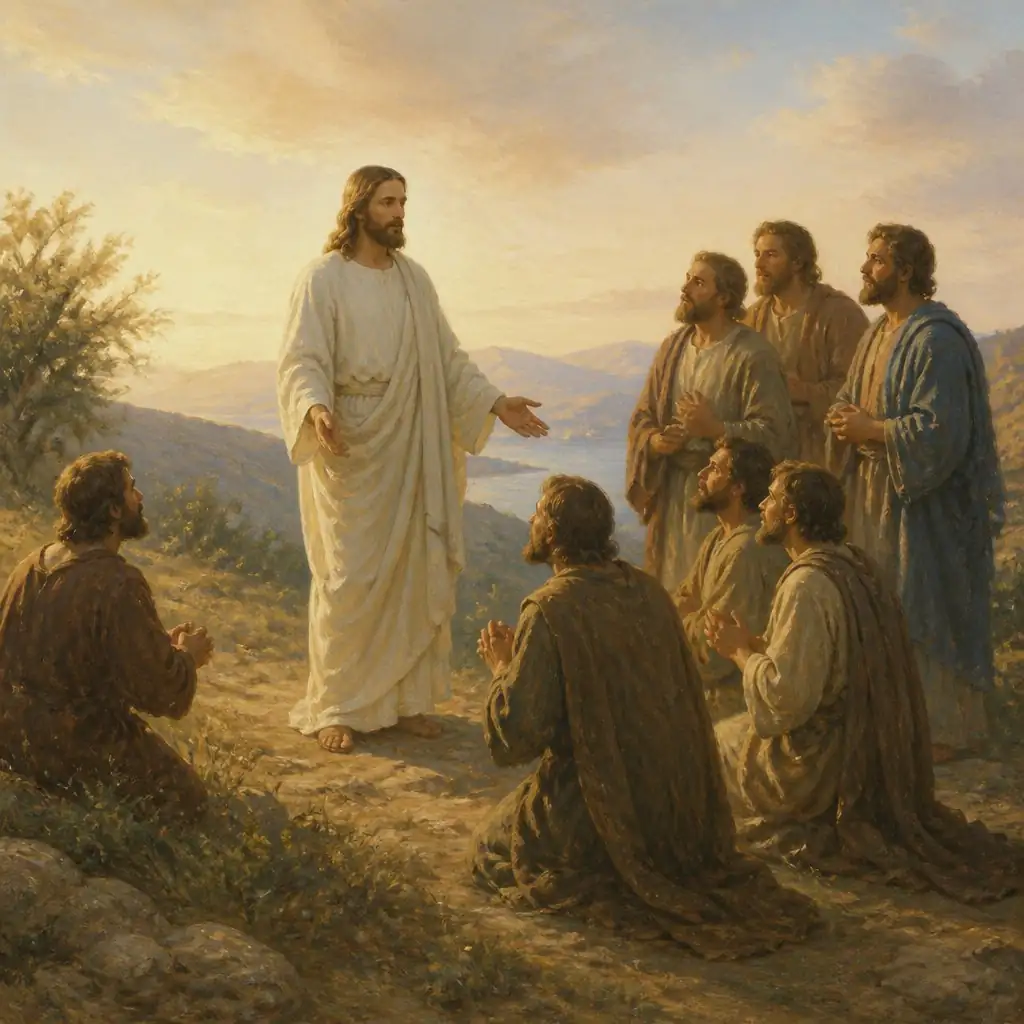
Yet, when the disciples fell down and worshipped Jesus after the resurrection, Jesus fully accepted it without a single word of correction (Matthew 28:17, John 20:28).
If Jesus is just a created “image” like an angel or a holy man, accepting worship is supreme blasphemy. Jesus accepted worship because He didn’t just reflect God’s character—He was God manifest in human flesh.
Q3: Did Jesus Exist From Eternal Past?
Kevin asks: “God is God for ever and ever. Psalm 90:2 says, ‘even from everlasting to everlasting, thou art God’. John 1:1-2 says that ‘in the beginning,’ the ‘Word was with God’. It doesn’t say, ‘from everlasting the Word was with God’. Can any Trinitarian show one Bible verse which says that Jesus existed from everlasting past?"
Answer
Kevin’s argument rests on the idea that “in the beginning” implies a starting point. But as we have already established grammatically, the word was (ēn) means Jesus was already there. If Kevin wants explicit verses placing Jesus in the “everlasting past,” the Scriptures provide them abundantly.
1. The Divine Status of the Son
Hebrews 1:8–12 and Psalm 45
In Hebrews 1:8, the New Testament records the Father directly addressing the Son, applying Psalm 45:6-7 to Him:
“Your throne, O God, is forever and ever.
A scepter of uprightness is the scepter of your kingdom.
You love righteousness and hate wickedness.
Therefore God, your God, has anointed you from among your companions with festive oil.”
– Psalm 45:6-7 LEB.
This text establishes absolute plurality within the Godhead—the Father calls the Son “God,” and refers to Himself as “your God.” Far from denoting inferiority, the Apostle Paul clarifies that Jesus did not consider “equality with God” something to be grasped (Philippians 2:6). How can Jesus be fully equal in nature to God and be a “lesser” God at the same time?
Hebrews 1:10–11 and Psalm 102:25
To prove this extends to the eternal past, we simply read two verses down in Hebrews 1:10–11 (quoting Psalm 102), where the Father says of the Son:
“You, Lord, laid the foundation of the earth in the beginning, and the heavens are the work of your hands; they will perish, but you remain ...”

If Jesus laid the foundation of the earth, He existed before the space-time universe was brought into being. He belongs to the uncreated realm of the eternal past.
2. The Overwhelming OT Evidence for His Eternal Origins
If Kevin wants the exact Hebrew equivalent of Psalm 90:2’s “from everlasting,” he needs to look at the famous messianic prophecy in Micah 5:2:
“But you, O Bethlehem Ephrathah ... from you shall come forth for me one who is to be ruler in Israel, whose coming forth is from of old, from ancient days.”
The Hebrew text uses the phrase mîmê ‘ōwlām (literally, “from the days of eternity”). This is the exact same vocabulary the Old Testament uses to describe the eternal nature of God the Father (e.g., Habakkuk 1:12). Micah clearly states that while the Messiah’s human birth happened in Bethlehem, His true origins are from the eternal past.
3. Jesus’ Own Testimony of Pre-Creation Existence
In John 17:5, Jesus prays a prayer that strict unitarianism cannot logically parse:
“And now, Father, glorify me in your own presence with the glory that I had with you before the world existed.”
Jesus does not say He was “thought of” or “planned.” He states He personally possessed equal divine glory face-to-face with the Father before the world existed. You cannot possess glory in the past if you do not exist in the past.
A Note on Submission and Equality
Unitarians frequently mistake the voluntary submission of the Son to the Father (such as in 1 Corinthians 15:28) as proof of ontological inequality. This is a logical error. In human relationships, if a wife willfully submits to her husband, or an employee follows the direction of a CEO, does it prove they are a lesser species or inherently inferior human beings? Of course not. Functional subordination does not equal ontological inferiority. In their divine essence, the Father and the Son are perfectly equal; in the economy of salvation, they hold distinct roles.
Q4: Wasn’t Jesus the “Firstborn of all Creation”?
Kevin says, “We all know that God has no beginning. John 1:1-2 say that ‘in the beginning was the word’. This clearly shows that Jesus (the Word) is not there from the eternal past. He was a created being. He was there only from the beginning of the universe. God has no beginning. So, what is the meaning of ‘beginning’ mentioned in John 1:1-2?”
Kevin goes on to conclude, from Revelation 3:14, Colosians 1:15-17, Psalm 2:7, that Jesus had a definite beginning. He says that Jesus was created before the rest of the universe was created. He further claims that the universe was created through Jesus, making him the “firstborn over creation.”
Answer
This clearly shows Kevin’s ignorance at multiple levels! Kevin’s argument relies heavily on a chronological reading of specific terms like “beginning” (archē) and “firstborn” (prōtotokos).
However, when we study these New Testament verses with a proper understanding of first-century Greek grammar, and the Old Testament background of those verses, we can see that his conclusions will not hold.
Here is a systematic presentation of biblical truth that upholds the eternal, uncreated pre-existence of the Son.
1. The Meaning of “Beginning” (archē) in John 1:1–2
Kevin argues that because the Word was “in the beginning,” the Word must have had a starting point. This completely misunderstands the grammar of the text.
The Grammatical Imperfect Verbs
John does not say, “In the beginning, the Word came into existence.” He uses the Greek word ἦν (ēn), which is the imperfect tense of eimi (to be). The imperfect tense denotes continuous, ongoing past state.
- The Greek word ēn implies that when the “beginning” occurred, the Word already was. He did not begin; He already existed. This was pointed out by preeminent New Testament Greek scholar Daniel B. Wallace (Greek Grammar Beyond the Basics, Zondervan).
- When John describes the creation of the universe in John 1:3 and the arrival of John the Baptist in John 1:6, he uses the Greek verb ἐγένετο (egeneto). It is the aorist tense of ginomai, meaning “came into being” or “became.” This is in direct contrast to the verb he used to describe the eternal existence of the Word (Jesus).
The Word Existed Before “The Beginning”
When John chose the phrase “In the beginning” to open his book, He intentionally echoed the opening phrase of the Hebrew Bible (Bereshit in Heb. / en archē in Gk).
However, while Genesis 1:1 describes the beginning of creation, John’s phrase “in the beginning” (en archē) goes even further back than “beginning” mentioned in Genesis. Using the imperfect tense, John 1:1 describes what existed before creation. The Logos (the Word) was already there before any “thing” was brought into being. The Word stood beside the Creator, possessing eternal self-existence. This was noted by the renowned scholar Leon Morris who specialized in John’s writings (The Gospel According to John, Eerdmans).
2. Exposing the Flaw in Kevin’s Cross-References
Kevin attempts to use Revelation 3:14, Colossians 1:15, and Psalm 2:7 to prove that the Son is a created being. Let’s look at what those texts actually mean in the biblical context.
Revelation 3:14 – “The beginning of the creation of God”
“And unto the angel of the church of the Laodiceans write; These things saith the Amen, the faithful and true witness, the beginning of the creation of God;” (KJV)
“And to the messenger of the assembly of the Laodiceans write: These things saith the Amen, the witness--the faithful and true--the chief of the creation of God” (Young’s Literal Translation)
Kevin apparently reads only the King James Bible. He reads the word “beginning” (archē) in this verse as “the first thing created.” However, in Hellenistic Greek, archē has a primary active meaning of “origin,” “source,” “ruler,” or “first cause.”
- The authoritative Greek-English Lexicon of the New Testament and Other Early Christian Literature (BDAG, p. 138) classifies the use of archē in Revelation 3:14 not as a passive starting point, but as “the moving cause,” meaning Jesus is the originator or source of God’s creation. Most modern translations of the Bible make this clear.
- This aligns with Revelation 1:8 and 22:13, where God (and later Jesus) is called the “Alpha and Omega, the First and the Last, the Beginning (archē) and the End.” God has no beginning, yet He is called the archē. Therefore, archē denotes supremacy and ultimate source, not a chronological start date.
Colossians 1:15 – “The firstborn of all creation”
Kevin argues that prōtotokos (firstborn) means Jesus was the first entity begotten or created. This is a fatal mistake in handling biblical idioms.
In Jewish and Greco-Roman culture, “firstborn” denoted rank, privilege, and supreme heirship, completely independent of birth order.
- Old Testament Precedent: In Psalm 89:27, God says of David: “And I will make him the firstborn (prōtotokos in the Septuagint), the highest of the kings of the earth.” Chronologically, David was the youngest son of Jesse (1 Sam 16:10-11). “Firstborn” here explicitly means “highest in rank.” Likewise, in Jeremiah 31:9, Ephraim is called the “firstborn” even though Manasseh was born first.
- The Immediate Context (Col 1:16-17): Paul clearly defines why Jesus is the prōtotokos over creation in the very next sentence: “For by him all things were created … all things were created through him and for him. And he is before all things ...”
- If Paul wanted to say Jesus was the first created being, he would have used the unambiguous Greek word πρωτόκτιστος (prōtoktistos), which literally means “first-created.” Instead, Paul deliberately chose prōtotokos to signify Christ’s absolute preeminence and ownership over creation, because He is its architect. (Bishop John Chrysostom pointed this out in his Homilies on Colossians). Besides, the Greek word prōtotokos in Colossians 1:15 expresses Christ’s sovereignty over the cosmos, not his placement inside it [Bishop N. T. Wright, The Epistles of Paul to the Colossians and Philemon, Eerdmans)].
Psalm 2:7 – “Today I have begotten you”
Kevin uses this verse to argue that the Son “came later.” However, the New Testament writers themselves tell us when this “today” occurred—and it wasn’t at a point before creation.
The Apostle Paul quotes Psalm 2:7 and applies it directly to the Resurrection and exaltation (Coronation) of Jesus:
“He has raised up Jesus, as it is also written in the second Psalm: ‘You are my Son, today I have begotten you.’” (Acts 13:32-33)
This is perfectly in line with the Ancient Near Eastern thought that every king received a new birth from God at the time of his coronation.
In Hebrews 1:5 and 5:5, the author links this “begotten” language to Christ’s historical incarnation and his formal enthronement as High Priest.
When Kevin says, “it is clear that Jesus was begotten from God …” what he actually wants to say is, “it is clear that Jesus was created or generated from God.” He misapplied the term “begotten” because he does not understand the historical meaning of that term.
In classical orthodox theology (championed by bishops Athanasius and Augustine), the term “only-begotten” (monogenēs) refers to an eternal, timeless relationship within the Godhead, not a physical or temporal event where a Father creates a Son. If you refer to the Son as “begotten not created,” you are essentially confessing that the Son has always existed. That’s perfectly in agreement with the truth about God. God has always been Father, which means the Son has always been Son.
Summary
| Verse | Kevin’s Misreading | Scholarly / Exegetical Reality |
|---|---|---|
| John 1:1 | “The beginning” means Jesus had a starting point. | The imperfect verb ēn (“was”) proves the Word already existed continuously before the beginning began. |
| Rev 3:14 | Jesus is the first object created. | archē means the “source,” “originator,” or “sovereign ruler” of creation. |
| Col 1:15 | Jesus is the firstborn child of the universe. | prōtotokos denotes supreme rank and heirship (as in Psalm 89:27). The context proves He is the Creator of “all things,” not a created thing. |
| Ps 2:7 | “Today” marks the moment Jesus was made. | The New Testament applies this verse to Jesus’ Resurrection (Acts 13:33) and His messianic enthronement. |
Q5: How Many “Gods” Are There In John 1:1?
Kevin asks, “If Jesus is God, won’t the verse ‘the Word was with God’ be read as ‘God was with God’, which means that God-1 was with God-2. How many Gods are there?”
Answer
Kevin’s objection is a classic problem that arises when one forces modern English syntax onto ancient Greek grammar and conflates the concept of Person (hypostasis) with Essence (ousia). John 1:1–2 does not teach “God-1 was with God-2.” Instead, it is a masterclass in first-century Greek precision, specifically designed to show that Jesus shares the exact same divine nature as the Father while remaining a distinct Person.
Here is how John 1:1 is a robust case for plurality within the one Godhead and the absolute deity of the Son.
Decoding the Grammar of John 1:1
Arians asks: “If Jesus is God, doesn’t John 1:1 mean ‘God was with God’ or ‘The Father was with the Father’?”
The Greek text solves this problem by using the definite article (“the”) with deliberate, mathematical precision.
Look at the latter two distinct clauses in John 1:1:
Clause B: kai ho logos ēn pros ton theon (literally, “and the Word was with the God”)
Clause C: kai theos ēn ho logos (literally, “and the Word was God”)
The Principle of Distinction (Clause B)
In Clause B, John uses the definite article “the” (ton) before “God” (theon).
In the New Testament, “the God” (ho theos) typically refers to the Person of God the Father. The preposition “with” (pros) literally means “face-to-face toward.” It indicates a close, personal relationship between two distinct entities. Therefore, Clause B establishes that the Word is a distinct Person from the Father. [As noted by world-renowned Greek grammarian Daniel B. Wallace, author of Greek Grammar Beyond the Basics, Zondervan.]
The Principle of Essence (Clause C)
Clause C: kai theos ēn ho logos (literally, “and the Word was God”)
In Clause C, John intentionally drops the definite article before the word “God” (theos). Such a noun without the definite article is called an anarthrous noun.
If John had included the article and written “and the Word was the God” (kai ho theos ēn ho logos), it would mean the Word and the Father are exactly the same Person. If the two are the same person, there is no room for a relationship between the Word and the Father; they would be the same Person. That is a heresy known as Modalism.
By omitting the definite article before the word “God” (theos), John makes the word “God” a qualitative predicate. A qualitative predicate describes the quality, nature, or characteristic of a subject.
That is, John is saying that the Word possesses the exact same divine nature as the Father.
[Note: In an important peer-reviewed study published in the Journal of Biblical Literature, scholar Philip B. Harner demonstrated that anarthrous predicate nouns preceding the verb primarily denote a quality or nature (“Qualitative Anarthrous Predicate Nominatives in John’s Gospel” JBL 92, no. 1, 1973).]
Theological Reality: John 1:1 does not mean “God-1 was with God-2.” It means: The Person who is the Word was in eternal, face-to-face relationship with the Person of God the Father, and the Word fully possessed the exact same divine essence as the Father.
| What Kevin Confuses | The Biblical and Grammatical Distinction |
|---|---|
| Being / Essence (ousia) | What God is. There is only one divine essence. Both the Father and the Son are this one God. |
| Person (Hypostasis) | Who God is. There are three distinct Persons sharing that one essence. The Father is not the Son, and the Son is not the Father. |
Jesus is not a “second God.” He is the eternal expression of the one, undivided divine essence, existing in perfect, eternal communion with the Father. To be the “Son of God” in a first-century Jewish context did not mean a lower rank; it meant equality of nature (as John 5:18 notes: “He was even calling God his own Father, making himself equal with God”).
Q6: God Is One. How Can Jesus Be Another God?
Kevin asks: “According to the first commandment, there is only one God. According to 1 Corinthians 8:6 and many other verses it is clear that the Father is the only one God. There cannot be two Gods or many Gods. There is only one God. So, Jesus cannot be God, he is the Son of God.”
Answer
Kevin quotes 1 Corinthians 8:6 to argue that because Paul calls the Father the “one God,” Jesus is excluded from divinity. This is arguably the most massive misreading of Pauline theology possible.
1. The Christological Shema
In 1 Corinthians 8:6, Paul writes:
“... yet for us there is one God, the Father, from whom are all things and for whom we exist, and one Lord, Jesus Christ, through whom are all things and through whom we exist.”
This verse does not strip Jesus of His divinity. Instead, it does the very opposite!
Paul is doing something revolutionary: he is redefining the Hebrew Shema (the ultimate Jewish monotheistic confession) from Deuteronomy 6:4:
“Hear, O Israel:
The LORD (Yahweh) our God, the LORD (Yahweh) is one”
- Paul took the two divine titles from the Shema—“God” (Elohim) and “LORD” (Yahweh)—and split them. He placed the Father under the title “God” and Jesus under the title “LORD” (Yahweh). This was pointed out by the leading New Testament scholar Richard Bauckham, author of Jesus and the God of Israel, Paternoster.
- Thus, Paul placed Jesus inside the unique divine identity of the one God of Israel.
- Furthermore, Paul says that all creation exists “through” Jesus. If the Creator Jesus were a created being, He would have to create Himself, which is a logical absurdity.
- Paul was not contrasting a divine Father with a human Jesus; he was maintaining strict monotheism while expanding it to reveal that the “One God” includes both Father and Son (N.T. Wright, in The Climax of the Covenant, T&T Clark).
2. Old Testament Foundations for Plurality in Divine Unity
The Bible indeed says that God is one. But monotheism in the Bible has never meant “absolute mathematical isolation.” The Old Testament routinely drops narrative and structural markers of a plurality of Persons within the single divine essence.
God is Uniquely United, Not Solitary (’eḥād vs. yāḥîd)
In the fundamental Jewish confession, known as the Shema, God’s oneness is fiercely defended:
“Listen, Israel: The LORD (Yahweh) is our God, the LORD (Yahweh) is one (’eḥād)!” (Deut 6:4)
In biblical Hebrew, two distinct words can be translated as “one”: ’eḥād and yāḥîd. As noted in lexical studies, yāḥîd means a solitary uniqueness or an “only” entity (e.g., Isaac as Abraham’s “only son” in Gen 22:2). Significantly, yāḥîd is never used in the Old Testament to define the oneness of Yahweh.
Instead, the Pentateuch utilizes ’eḥād, a word that fundamentally permits a compound unity—a single entity comprised of distinct parts. For example:
Similar usages of ’eḥād in the Old Testament include these examples:
- Genesis 1:5: Evening and morning comprise “one (’eḥād) day.”
- Genesis 2:24: A husband and wife become “one (’eḥād) flesh.”
- Ezra 2:64: The entire assembly was as “one (’eḥād).”
The choice of ’eḥād in the Shema intentionally affirms the unified nature of Yahweh without reducing His inner life to a solitary, mathematical monad.
The Deliberate Plural Pronouns (Gen 1:26 & Isa. 6:8)
In Genesis 1:26, God announces:
“Let us make man in our image, after our likeness.”
Similarly, in Isaiah 6:8, Yahweh speaks using both singular and plural pronouns in a single breath of poetic parallelism:
“Whom shall I send,
and who will go for us?”
While mainstream Old Testament scholarship (e.g., Gordon Wenham, Genesis 1-15) demonstrates that the immediate literary context implies God addressing His heavenly court or divine council, a crucial theological distinction remains: the heavenly army of angels does not create. In the very next verse (Gen 1:27), the text immediately shifts back to strict singular verbs:
“So God created (bārā’, singular) man in his own image … male and female he created them.”
The text carefully balances a plural consultation with a strictly singular execution. This syntax leaves open what Christian theologians recognize as the internal, interpersonal communion of the Godhead acting in creation.
Genesis 19:24 – The Two Yahwehs
In the destruction of the cities of the plain, the Hebrew text presents a striking spatial duality of the Divine identity:
“Then Yahweh rained on Sodom and Gomorrah sulfur and fire from Yahweh out of heaven.” (Genesis 19:24)
Unitarian commentators frequently dismiss this as a mere literary idiom for emphasis (a redundant appositive). However, rigorous textual analysis reveals a deliberate narrative distinction: Yahweh, manifesting personally on earth (having just eaten and conversed face-to-face with Abraham in Genesis 18), acts in perfect tandem with Yahweh remaining enthroned in the heavens. It is an explicit Old Testament demonstration of personal plurality operating within the singular identity of Yahweh.
The Divine Triad in Isaiah 48:12–16
Isaiah 48 provides one of the clearest structural outlines of plurality within the operational framework of God. The speaker introduces Himself with absolute divine titles:
“Listen to me, O Jacob... I am he; I am the first, and I am the last. My hand laid the foundation of the earth ...” (Isa 48:12-13)
There is no doubt that the speaker is Yahweh the Creator. Yet, in verse 16, this exact same sovereign speaker declares:
“Draw near to me; hear this!
I have not spoken in secrecy from the beginning;
from the time it came to be, there I have been;
And now the Lord Yahweh has sent me and his Spirit.” (Isaiah 48:16)
An analysis of the subjects in this passage reveals three distinct entities:
- The Sent: Jehovah, who identifies Himself as the First and the Last, and the Creator of the world (v. 12-13)
- The Sender: The Lord Yahweh (Adonai Yahweh). Jehovah sends Jehovah the Speaker
- The Accompanying Agent: The Spirit of God (rūach elohim).
The passage presents a clear Triadic operational unity where Yahweh sends Yahweh alongside the Spirit.
The Angel of Yahweh With the Divine Essence: Ex 23:20–22
Strict unitarianism cannot account for the Old Testament figure known as the Angel of Yahweh (Malak Yahweh), who routinely claims divine identity, accepts worship, and exercises divine prerogatives.
In Exodus 23, God gives Moses explicit parameters regarding this unique Guide:
“Be attentive to him and listen to his voice; do not rebel against him, because he will not forgive your transgression, for my name is in him.” (Exod 23:21)
What does this mean? Here’s a summary:
In ancient Near Eastern thought, a person’s “name” (shem) was synonymous with their literal presence, authority, and ontological essence. God states that this Angel possesses the authority to withhold forgiveness of sins—a right that strict monotheism reserves exclusively for God alone (Mark 2:7).
The ontological unity of Yahweh and this Angel is proven in the historical fulfillment. Who brought Israel out of Egypt?
- Leviticus 11:45: “I am Yahweh, who brought you up from the land of Egypt.”
- Judges 2:1: “And the angel of Yahweh went up... and said, ‘I brought you up from Egypt, and I brought you to the land that I had promised to your ancestors.’”
The Old Testament deliberately interchanges Yahweh and the Angel of Yahweh because the Angel is the visual, personal manifestation of the invisible Godhead—the pre-incarnate Son who shares the full divine essence of the Father.
The concept of plurality within the Godhead was already present in the Old Testament!
3. Philosophical Necessities for Plurality
While textual analysis of the Bible is vital, strict unitarianism also collapses under the weight of logical and philosophical coherence. When we analyze the eternal attributes of God – specifically His Personhood and His Loving Nature – we find that a solitary, one-person deity creates severe philosophical contradictions.
Argument 1: The Ontological Demands of Divine Personhood
The God of the Bible is revealed as a personal being, possessing consciousness, a will, and the capacity for interpersonal relationship. He is not an impersonal cosmic energy or a static force. However, by definition, personhood is inherently relational. A person cannot manifest personal attributes – such as communication, fellowship, or a shared will – in absolute, mathematical isolation.
In the eternity past, before any created matter, angels, or humans existed, God was already fully personal. If God were a solitary, single person, His personhood would have been entirely dormant, unactualized, or non-existent for an eternity. A unitarian God would require the creation of other beings just to have someone to interact with, thereby making God’s personal fulfillment dependent upon His creation.
This violates the foundational biblical doctrine of divine aseity (that God is entirely self-sufficient and independent of creation). As the theologian Francis Schaeffer noted (in The God Who Is There), the Trinitarian model resolves this completely: God did not need to create the universe to be communicative or relational, because the Father and the Son have eternally communicated and related to one another in the unity of the Spirit.
Argument 2: The Logical Necessity of Eternal Love
The New Testament defines God’s very essence by stating: “God is love” (1 John 4:8). It does not say God acquired love or that God acts lovingly; love is His fundamental, eternal nature.
Philosophically, love cannot exist in a vacuum. Love intrinsically requires three distinct elements: a Lover, a Beloved, and the Spirit of love shared between them. If God were a single, isolated person existing alone in eternity past, He could not have been “love,” because there was no object to receive His love. If a unitarian God wished to express love, He would have faced a fatal dilemma:
- He could only love Himself, which reduces the eternal essence of God to absolute self-absorption or narcissism.
- Or, He had to create humans or angels to finally have an object to love, which again makes God dependent on creation to fulfill His own nature.
As C.S. Lewis brilliantly observed in Mere Christianity, the statement “God is love” has zero logical meaning unless God contains a plurality of Persons. Perfect, self-giving love requires an equal partner to receive and return that love.
This philosophical reality was first formalized by the medieval theologian Richard of Saint Victor (De Trinitate), who argued that supreme charity (love) must be directed toward another who is equally divine. Furthermore, Richard noted that perfect love goes beyond a mere two-way partnership; it naturally overflows to desire a Third Person to share in that mutual joy.
Therefore, the Trinity is a philosophical necessity: the Father has eternally poured out perfect love upon the Son, and the Son upon the Father, through the Holy Spirit, making God entirely self-sufficient, completely satisfied, and truly “Love” before the cosmos ever began.
Q7: Did Translators Get Romans 9:5 Wrong?
In his epistle to the Romans, the apostle Paul talks about the “constant distress” he experiences when he thinks about the miserable state of his people, the Jews, on account of their rejection of the Messiah. He then lists the privileges the Jewish nation enjoyed by virtue of God’s decision to choose them as channels of His blessings to the nations. Towards the end of that list, Paul mentions that even the Messiah has a physical link to the Jewish people. To underscore the greatness of that blessing, Paul describes the Messiah as “God over all” and declares Him to be “blessed forever.” This verse is very special because it praises Jesus using a doxology which is usually reserved for God the Father.
I am speaking the truth in Christ—I am not lying; my conscience confirms it by the Holy Spirit—2I have great sorrow and unceasing anguish in my heart. 3 For I could wish that I myself were accursed and cut off from Christ for the sake of my own brothers and sisters, my own flesh and blood. 4They are Israelites, and to them belong the adoption, the glory, the covenants, the giving of the law, the worship, and the promises; 5 to them belong the patriarchs, and from them, according to the flesh, comes the Christ, who is over all, God blessed forever. Amen.
– Romans 9:1-5 NRSV
It is not surprising that Unitarians and Arians like Kevin have a problem with Romans 9:5. Kevin alleges:
“Translators of most Bible versions got Romans 9:5 wrong! Only the Revised Standard Version and Complete Jewish Bible got it right. Jesus is not God. The phrase that blesses God is a separate sentence, not a description of Jesus. It is a benediction.”
A Response
It is not surprising that Unitarians and Arians have a problem with Romans 9:5. They favor the “safer” translation offered by RSV, in which, “God who is over all be blessed for ever” is given as a separate sentence.
“… to them belong the patriarchs, and of their race, according to the flesh, is the Christ. God who is over all be blessed for ever. Amen.”
Before we examine the verse, let us briefly examine the nature of the problem.
The Greek text of Romans 9:5 is not problematic. The issue is a disagreement between Greek scholars about how the verse must be punctuated.
The original Greek New Testament contained no punctuation marks. The entire text consisted of one long stream of capital letters with no spaces between words, no lowercase letters, and no breaks for paragraphs or sentence. Spaces between words, punctuation, and chapter divisions came much later. These were introducted by editors.
Here is the Greek text without punctuation:
ων οι πατερες και εξ ων ο χριστος το κατα σαρκα ο ων επι παντων θεος ευλογητος εις τους αιωνας αμην
Until the late 19th century, there were no controversies regarding this verse. From the late 19th to mid-20th century, questions were raised about how this verse should be punctuated.
- Traditionally, there was a comma after the word “flesh.” The words that followed (who is over all, God blessed forever) would then be applied to “the Christ.”
- Should there be a full stop or colon after the word “flesh”? That would make the clause “who is over all, God blessed forever” independent of “the Christ.”
- Alternatively, should there be a comma after the word “flesh” and a full stop after “over all”? That would produce: “Christ, according to the flesh, who is over all. God [be] blessed forever. Amen”
In the 19th century, scholars like Westcott and Hort concluded that the text should be punctuated to read: “... Christ according to the flesh, who is over all, God blessed forever”. This directly calls Jesus “God.” However, under the influence of unitarians (who reject the doctrine of trinity), the 19th edition of Nestle Aland’s Greek New Testament (1949) introduced a semi-colon after the word “flesh.” The 3rd edition of United Bible Society’s Greek New Testament (1975), too, did the same.
English Bible versions, such as the Revised Standard Version (RSV), the TEV (1966), NLV (1969), etc., were emboldened to introduce the variant reading within the body of the biblical text. It must be remembered that, starting from the late 19th century, a few revised versions had managed to slip in the variant reading into the margins and footnotes. They did not go as far as putting that variant reading in the main text. This changed from the 1960s.
This is why Unitarian and Arians gladly cite the RSV and Complete Jewish Bible as “correct” translations. They trash other versions are “wrong translations.” But they must update themselves! The popularity of the “new perspective” on Romans 9:5 quickly waned. The 26th edition of Nestle Aland’s Greek New Testament (NA27) removed the semi-colon after the word “flesh” and introduced a comma in its place. The United Bible Socieites too followed suit. Their corrected editions was introduced in 1983 (USB3) and 1993 (USB4). The USB5 published in 2012 maintains status quo.
The popular Greek New Testaments are now back to square one! The clause “who is over all, God blessed forever” now applied to the Lord Jesus Christ. The English versions that went astray need to get back to the truth.
We must note that the New Revised Standard Version (NRSV) took a bold step to correct the error committed in the RSV. That is why I cited the passage Romans 9:1-5 from the NRSV.
Take a look at these important English Bible versions that remain faithful to the original Greek text.
New American Standard Bible 1995 – “whose are the fathers, and from whom is the Christ according to the flesh, who is over all, God blessed forever. Amen.”
Amplified Bible – “To them belong the patriarchs, and from them, according to His natural descent, came the Christ (the Messiah, the Anointed), He who is exalted and supreme over all, God blessed forever. Amen.”
Holman Christian Standard Bible – “The ancestors are theirs, and from them, by physical descent, came the Messiah, who is God over all, praised forever. Amen.”
NET Bible – “To them belong the patriarchs, and from them, by human descent, came the Christ, who is God over all, blessed forever! Amen.”
Aramaic Bible in Plain English – “… and the Patriarchs; and from them The Messiah appeared in the flesh, who is The God Who is over all, to Whom are praises and blessings to the eternity of eternities, amen.”
English Standard Version – “To them belong the patriarchs, and from their race, according to the flesh, is the Christ, who is God over all, blessed forever. Amen.”
Why is the traditional translation the right one?
Here are four reasons why the traditional rendering of Romans 9:6 is the most accurate and faithful one.
- Firstly, the traditional translation is the most natural one. There is no need to split the verse using a semi-colon or a full stop. The phrase “who is” naturally refers to the Christ. Therefore, the phrase “God blessed forever” must apply to the Christ.
- Secondly, in all doxologies in the Old and New Testaments, the word “Blessed” (εὐλογητὸς) appears at the beginning. However, in Romans 9:5, this word comes after theos, the word for “God”. This is a clear indication that the apostle Paul was not writing a doxology. The phrase “blessed forever” is descriptive, not a doxology. It describes Jesus Christ. Therefore, there is no need to insert a full stop (period) after the word “Christ” and to create an unnatural-sounding doxology.
- Thirdly, if the phrase were a doxology, it would be an asyndetic doxology. That is, it would be a sudden outburst of praise without any connection to the sentence before it. As such, there is no connection word such as “and” or “but.” Pauline doxologies are never asyndetic. Moreover, asyndetic doxologies in the Bible and other semitic literature are written differently. Unlike what is seen in Romans 9:5, they invariably have a verb or verbal adjective preceding the name of God.
- Finally, Romans 9:5 must be understood in its literary context. The apostle expresses his grief concerning the Jewish nation that failed to believe in Jesus, the Messiah. He portrays the Israelites as a nation that enjoyed various privileges. He lists out these privileges in the order of their importance: the adoption belonged to them; the glory, the covenants, the Law, the worship and sacrifices in the temple, the promises of God, and the Patriarchs. Paul presents the coming of Jesus as an Israelite as the climax of a series of blessings the Israelites enjoyed. But Paul mentions that this connection between Jesus and Israel was restricted to his bodily origin: “according to the flesh.” If that sentence were to end there, this relationship between Israel and Jesus cannot serve as the climax in this list. Instead of being seen as a blessing, it would be understood as a very limited relationship. Therefore, Paul does not stop the sentence there. He goes on to say that Messiah who descended from Israelites is supreme over all and is God who is blessed forever. By referring to Jesus as God, Paul counterbalances the restrictive phrase “according to the flesh” and adds glory to Israel. He was in effect saying, “Look! As the greatest blessing Israelites received, the blessed God himself became a human through them and was exalted as Messiah over all.”
The so-called “new perspective” on Romans 9:5 was a misadventure in falsehood. Why does false teachers always target the glory and stature of the Lord Jesus Christ?
Q8: Do More Verses Say Jesus Is “God”?
While Kevin takes his time to digest the implications of Romans 9:5, let us meditate on other verses in the New Testament that address Jesus as God.
2 Peter 1:1
KJV: “Simon Peter, a servant and an apostle of Jesus Christ, to them that have obtained like precious faith with us through the righteousness of God and our Saviour Jesus Christ:”
NJKV: “Simon Peter, a bondservant and apostle of Jesus Christ, To those who have obtained like precious faith with us by the righteousness of our God and Savior Jesus Christ:”
NASB 1995: “Simon Peter, a bond-servant and apostle of Jesus Christ, To those who have received a faith of the same kind as ours, by the righteousness of our God and Savior, Jesus Christ:”
NIV: “Simon Peter, a servant and apostle of Jesus Christ, To those who through the righteousness of our God and Savior Jesus Christ have received a faith as precious as ours:”
Amplified Bible: “Simon Peter, a bond-servant and apostle (special messenger, personally chosen representative) of Jesus Christ, To those who have received and possess [by God’s will] a precious faith of the same kind as ours, by the righteousness of our God and Savior, Jesus Christ:”
ISV: “From: Simeon Peter, a servant and apostle of Jesus, the Messiah. To: Those who have received faith that is as valuable as ours through the righteousness of our God and Savior, Jesus the Messiah.”
NET Bible: “From Simeon Peter, a slave and apostle of Jesus Christ, to those who through the righteousness of our God and Savior, Jesus Christ, have been granted a faith just as precious as ours.”
Legacy Standard Bible: “Simeon Peter, a slave and apostle of Jesus Christ, To those who have received the same kind of faith as ours, by the righteousness of our God and Savior, Jesus Christ:”
World English Bible: “Simon Peter, a servant and apostle of Jesus Christ, to those who have obtained a like precious faith with us in the righteousness of our God and Savior, Jesus Christ:”
In 2 Peter 1:1, the terms “God” and “Savior” refer to one person – Jesus Christ. These words are not referring to two persons. How do we know that?
1. The Granville Sharp Rule of Greek Syntax
Linguist Granville (1798) laid down this principle: when two singular, personal, non-proper nouns are connected by a copulative conjunction (kai / “and”), and the first noun has the definite article (tou / “the”) while the second does not, both nouns refer strictly to the same person.
In 2 Peter 1:1, we note that:
- the article tou (“the”) appears only once, modifying “God”
- the conjuction kai (“and”) joins the terms God and Savior
- the second noun soteros (“savior”) lacks an article.
Therefore, since this verse fits the criteria of Sharp’s rule, the terms GOD and SAVIOR are locked to the singular trailing proper name: Jesus Christ.
2. The Internal Context of 2 Peter
Apostle Peter uses the exact “article-noun-kai-noun” framework four othertimes to link “Lord” and “Savior” to Jesus Christ.
- 1:11 “… the eternal kingdom of our Lord and Savior Jesus Christ.”
- 2:20 “… the knowledge of our Lord and Savior Jesus Christ.”
- 3:2 “… the commandment of our Lord and Savior Jesus Christ.”
- 3:18 “… the grace and knowledge of our Lord and Savior Jesus Christ.”
There is no debate about whether the two terms “Lord” and “Savior” refer to one single person (Jesus) in the above four verses. Therefore, Richard Bauckham argues that there should not be any debate about whether the two terms “God” and “Savior” in 2 Peter 1:1 refer to the same person Jesus.
Titus 2:13
Titus 2:13 is yet another Bible verse that declares Jesus as God.
Amplified Bible: “… our great God and Savior, Christ Jesus, …”
New KJV: “… our great God and Savior Jesus Christ, …
NASB 1995 “… our great God and Savior, Christ Jesus, …”
Greek NT (WHNU) “… του μεγαλου θεου και σωτηρος ημων χριστου …”
This is another example of Greek expression where the Granville Sharp Rule of Greek Grammar must be applied.
The improper nouns “God” and “Savior” apply to the proper noun Jesus because the Greek definite article του appears only once, and that too, before the first improper noun “God”.
We cannot brush aside such crystal clear declarations about the divinity of Jesus Christ and still imagine that we are sincere students of the Bible. It takes utter spiritual blindness and a wicked, dishonest heart to suppress the truth of God’s Word.
Q9: Is the Triadic Formula in Matthew 28:19 authentic?
The command in Matthew 28:19 to “make disciples of all nations, baptizing them in the name of the Father and of the Son and of the Holy Spirit” (NRSV) stands as one of the most important passages in the New Testament. In modern debates, groups that reject the Trinity frequently argue that the triad—“of the Father and of the Son and of the Holy Spirit”—was not part of Matthew’s original Gospel. Instead, they claim it was added later in the 200s or 300s AD during Nicene debates about the nature of God.
This argument fails when we examine ancient copies of the Bible, early Christian writings, and the overall story of Matthew. The triadic formula of Matthew 28:19 is a genuine and original of the First Gospel.
I. Evidence from Ancient Manuscripts and Early History
1. Complete Agreement Among Greek Copies
In textual criticism, the primary criterion for establishing the original text of any document is the external witness of extant manuscripts. On this count, Matthew 28:19 possesses an unbroken chain of transmission.
There is no surviving Greek manuscript of Matthew’s Gospel that omits the triadic formula. It is found in every major early manuscript written in capital letters, including:
- Codex Sinaiticus (A) (c. 330–360 AD)
- Codex Vaticanus (B) (c. 325–350 AD)
- Codex Ephraemi Rescriptus (C) (5th century)
- Codex Washingtonianus (W) (4th–5th century)
In addition, the phrase is present in all ancient translations, including the Old Latin (Vetus Latina), the Vulgate, the Syriac traditions (Peshitta and Harklean), and the Coptic (Sahidic and Bohairic) versions. Standard scholarly editions of the Greek New Testament – like Nestle-Aland (NA28) or the United Bible Societies (UBS5) – do not list a single manuscript that leaves these words out. From a scholarly standpoint, a phrase supported by 100% of the Greek manuscript record cannot be rejected without overwhelming proof.
2. Quotes from Early Christian Writers Before Nicaea
A common claim among Unitarians is that the triadic formula was retrofitted into manuscripts after the Council of Nicaea (325 AD). However, clear attestations appear in Christian writings that predated Nicaea by generations.
The Didache (c. 60–120 AD): The early manual of church order explicitly mandates baptism using the triadic phrase:
“Concerning baptism, baptize this way: Having first said all these things, baptize into the name of the Father, and of the Son, and of the Holy Spirit, in running water.” (Didache 7.1)
Justin Martyr (c. 155 AD): In his description of Christian initiation, Justin writes:
“For, in the name of God, the Father and Lord of the universe, and of our Savior Jesus Christ, and of the Holy Spirit, they then receive the washing with water.” (First Apology, 61)
Irenaeus of Lyons (c. 180 AD): Irenaeus quotes the verse explicitly as a mandate given directly by Christ:
“And again, giving to the disciples the power of regeneration into God, he said to them, 'Go and teach all nations, baptizing them in the name of the Father, and of the Son, and of the Holy Spirit.’” (Against Heresies, III.17.1)
Tertullian (c. 198 AD): Writing against Monarchian theology, Tertullian notes:
“He commands them to baptize into the Father, and the Son, and the Holy Ghost, not into a unipersonal God.” (Against Praxeas, 26; cf. On Baptism, 13)
Hippolytus of Rome (c. 215 AD): In the Apostolic Tradition, Hippolytus records a threefold interrogation during baptism corresponding to the Father, Son, and Holy Spirit (Apostolic Tradition, 21).
Cyprian of Carthage (c. 250 AD): Cyprian repeatedly cites Matthew 28:19 in his letters on the validity of heretical baptism, stating that Christ explicitly commanded the nations to be baptized in the full Trinity (Epistle 72 to Jubaianus).
These citations demonstrate that the formula was not a 4th-century development; it was read, quoted, and practiced liturigically across the Roman Empire in the 1st, 2nd, and 3rd centuries.
II. Evidence from the Gospel's Story and Grammar
Far from being an added-on addition or foreign body (Fremdkörper), the trinitarian phrase serves as the natural climax to the central message and story of Matthew's Gospel (Van Zyl, 2022).
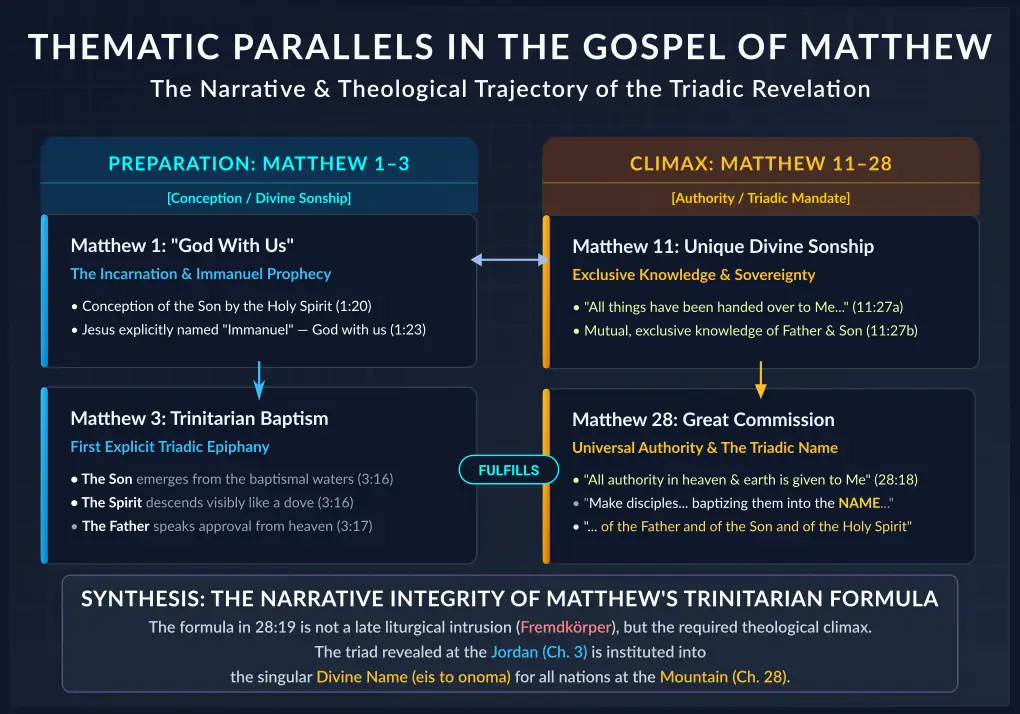
1. Themes about Jesus and God Throughout Matthew
- The Incarnation (Matt 1:20–23): The story opens with the Holy Spirit conceiving the Son, who is named Immanuel—*"God with us."
- The Baptism of Jesus (Matt 3:13–17): All three divine persons appear together: the Son emerges from the water, the Spirit descends like a dove, and the Father speaks from heaven. Matthew 28:19 brings the reader back to this same revelation of God revealed at Jesus' baptism.
- The Revelation of Authority (Matt 11:27): Jesus says that “all things have been handed over to me by my Father,” and that no one knows the Father except the Son and those to whom the Son reveals Him. This points forward to Jesus' claim of total authority (“All authority in heaven and on earth has been given to me”) in Matthew 28:18.
2. The Meaning of the Grammar: “In the Name”
The singular noun “name” (ὄνομα, onoma) followed by three distinct entities—the Father, the Son, and the Holy Spirit—is grammatically significant. The text does not say “in the names” (plural), nor does it repeat the preposition “in the name of the Father, and in the name of the Son …”
This phrasing reflects an early Jewish-Christian way of showing that all three Persons share one divine nature. As NT scholar Murray J. Harris notes, the singular onoma underscores a shared divine identity and authority, expressing a triune unity in early high Christology.
III. Answers to Common Counterarguments
1. The Eusebian “Shorter Reading”
Objection: Eusebius of Caesarea (c. 260–339 AD), in his pre-Nicene works (such as the Demonstratio Evangelica), often cited Matthew 28:19 as “Go and make disciples of all nations in my name.” Critics argue this proves that a shorter version of the verse existed before the Council of Nicaea.
Refutation:
- Citation Style: Eusebius was not trying to give precise Bible quotes in these books; he often shortened, summarized, or rephrased Bible passages to fit his main point, which was a common practice among ancient writers.
- Focus of the Context: Eusebius often quoted only “in my name” when he was focusing specifically on how the Church spread to non-Jewish nations through the power of Jesus' name, leaving out the baptism instructions because they were not relevant to his point.
- Eusebius Used the Full Formula Elsewhere: In writings where baptism or church teaching was the main topic – including his post-Nicene works and his Letter to the Church at Caesarea (325 AD) – Eusebius explicitly quotes the full triadic formula.
- Chronological Inconsistency: Earlier writers like Justin Martyr and Irenaeus quoted the full phrase more than a century before Eusebius was born. A shorter quote by Eusebius cannot replace earlier manuscript evidence and older quotes.
2. Baptism “In the Name of Jesus” in the Book of Acts
Objection: The Book of Acts records early Christian baptisms being performed “in the name of Jesus Christ” (Acts 2:38, 10:48) or “in the name of the Lord Jesus” (Acts 8:16, 19:5), without mentioning the Father and Holy Spirit.
Refutation:
Description vs. Liturgical Formula: NT scholars distinguish between a descriptive narrative of baptism and an exact liturgical formula. As Everett Ferguson explains in Baptism in the Early Church:
“The phrases in Acts may not reflect alternative formulas in the administration of baptism … In some cases the description in Acts may mean a baptism administered on a confession of Jesus as Lord... a general characterization of the baptism as related to Jesus and not a formula pronounced at the baptism.” (Ferguson, 2009, p. 136)
Distinction from Johannine Baptism: In the context of Acts, baptizing "in the name of Jesus" served to distinguish Christian baptism from John the Baptist's baptism of repentance (Acts 19:1–6) or Jewish ceremonial washings. It showed whose authority the baptism belonged to, rather than listing the exact words spoken over the person being baptized.
3. The “Nicene Conspiracy” Theory
Objection: Critics claim that church leaders secretly added the three-part phrase into all Christian Bible copies after the Council of Nicaea (325 AD) to support their official teachings about God.
Refutation:
- Historically Impossible: In the 300s AD, the Church had no central power that could collect, change, and re-distribute every Greek, Latin, Syriac, and Coptic Bible copy across Europe, North Africa, and Asia.
- Silence of the Arian Controversy: During the 300s AD, there were fierce debates between Christians who supported Nicaea and those who opposed it (called Arians). If supporters of Nicaea had changed Matthew’s Gospel, their opponents would have called them out for altering the text. Yet, no opponent ever accused them of changing Matthew 28:19. Both sides accepted the verse as original.
4. The Medieval Hebrew Gospel of Matthew (Shem Tov)
Objection: The 14th-century Hebrew manuscript of Matthew preserved in Shem Tov Ibn Shaprut’s Touchstone (Even Bohan) lacks the triadic formula, rendering it as “Go and [make them holy/teach them] …”
Refutation:
- Late Date and Intent: Shem Tov’s text dates to the late 14th century (c. 1380 AD) and was embedded within a Jewish debate book written specifically to argue against Christian beliefs.
- Textual Corruption: Textual critics (such as William Horbury and George Howard) acknowledge that while Shem Tov’s text contains some older readings, it shows clear signs of medieval copying errors, translations back from Latin, and deliberate edits to remove references to the Trinity.
- Other Hebrew Manuscripts: Other medieval Hebrew translations of Matthew, such as the Münster Hebrew Matthew (1537) and the Du Tillet Hebrew Matthew (1555), do contain the full triadic formula. A medieval text written over a thousand years later cannot replace the agreement of ancient 4th-century Greek copies and 2nd-century Christian quotes.
Conclusion
The claim that Matthew 28:19’s Trinitarian formula is a late addition lacks support in textual criticism, church history, and narrative analysis.
- Textual Evidence: Supported by 100% of surviving Greek manuscripts and ancient translations.
- Historical Attestation: Quoted continuously by Church Fathers starting from the late 1st century (Didache, Justin Martyr, Irenaeus).
- Theological Fit: Serves as the natural culmination of Matthew’s overarching narrative regarding the identity and authority of Jesus.
The triadic formula is a genuine text of Matthew’s Gospel, reflecting the early Apostolic practice and understanding of the Triune God.
Share this page!

Select Bibliography
Books
Bauckham, Richard J. God Crucified: Monotheism and Christology in the New Testament. Wm. B. Eerdmans Publishing, 1999.
Bauckham, Richard J. God Crucified: Monotheism and Christology in the New Testament. Wm. B. Eerdmans Publishing, 1999.
Bauckham, Richard J. Jesus and the God of Israel: God Crucified and Other Studies on the New Testament’s Christology of Divine Identity. Wm. B. Eerdmans Publishing, 2008.
Bauckham, Richard J. Jude, 2 Peter Word Biblical Commentary, Vol. 50, 1983.
Ferguson, Everett. Baptism in the Early Church: History, Theology, and Liturgy in the First Five Centuries. Grand Rapids: Wm. B. Eerdmans Publishing, 2009.
Harris, Murray J. Jesus as God: The New Testament Use of Theos in Reference to Jesus Baker Academic, 1992.
Heiser, Michael S. The Unseen Realm: Recovering the Supernatural Worldview of the Bible. Lexham Press, 2015.
Hundu, Jacob T. “Examining the Evidence: The Case for and Against the Authenticity of Matthew 28:19.” The American Journal of Biblical Theology 25, no. 42 (2024).
Hurtado, Larry W. Lord Jesus Christ: Devotion to Jesus in Earliest Christianity. William B. Eerdmans Publishing, 2003.
Tilling, Chris. Paul’s Divine Christology. Eerdmans, 2015.
Van Zyl, Hermias C. “The Trinitarian Formula of Matthew 28:19: Fremdkörper or an Appropriate Conclusion?” Verbum et Ecclesia 43, no. 1 (2022): 1–9. https://doi.org/10.4102/ve.v43i1.2673
Wallace, Daniel B. Greek Grammar Beyond the Basics: An Exegetical Syntax of the New Testament Zondervan, 1996.
Wright, Christopher J. H. Knowing Jesus Through the Old Testament. 2nd ed., InterVarsity Press, 2014.
Wright, N. T. The Challenge of Jesus: Rediscovering Who Jesus Was and Is. InterVarsity Press, 1999.
Articles
Detailed study of Romans 9:5 in Greek was done by these English, French, and German scholars:
Dwight, Timothy. “On Romans ix. 5.” Journal of the Society of Biblical Literature and Exegesis, vol. 1, no. 1, 1881, pp. 22-55. doi.org/10.2307/3268719.
Abbot, E. “On the Construction of Romans ix.5.” Journal of Biblical Literature 1 (1881): 87-154.
Abbot, E. “Recent Discussions on Romans ix.5.” Journal of Biblical Literature 3 (1883): 90-112.
Durand, A. “La divinité de Jésus-Christ dans S. Paul, Rom ix,5.” Rwue Biblique 12 (1903): 550-70.
Faccio, H. M. De divinitate Christi juxta S. Paulum, Rom. 9,5. Jerusalem: Franciscan Printing Press, 1945.
Metzger, B. M. “The Punctuation of Romans 9:5.” pp. 95-112 in Christ and Spirit in the New Testament: Festschrift in Honour of C. F. D. Moule. Edited by B. Lindars and S. S. Smalley. Cambridge: Cambridge University Press, 1973.
Kuss, O. “Zur Römer 9,5.” pp. 291-303 in Rechtfertigung: Festschrift für Ernst Käsemann zum 70. Geburtstag. Edited by J. Friedrich, W. Pohlmann, and P. Stuhlmacher. Tübingen: Mohr, 1976.
Ante-Nicene Fathers
The earliest Ante-Nicene Fathers repeatedly affirmed Christ’s full deity. These later became foundational in the Church’s response to Arianism at the First Council of Nicaea in AD 325. Below is an annotated bibliography of the most important primary sources. These resources are available for free online.
1. Ignatius of Antioch. The Epistles of St. Ignatius. Translated by J. B. Lightfoot and J. R. Harmer, Baker Book House, 1989.
Written around AD 107 while en route to martyrdom, Ignatius repeatedly calls Jesus “our God.” His letters to the Ephesians, Romans, and Smyrnaeans provide some of the earliest explicit testimony to Christ’s deity after the New Testament. Arians struggled to explain these statements because they predate the Nicene controversy by more than two centuries.
2. Justin Martyr. Dialogue with Trypho. Translated by Thomas B. Falls, Catholic University of America Press, 2003.
Justin identifies Christ as the divine Logos who appeared to the patriarchs and as the Angel of the Lord in the Old Testament. He distinguishes the Father and the Son without denying the Son’s eternal divinity, making this work especially valuable in tracing pre-Nicene Logos theology.
3. Irenaeus (of Lyons). Against Heresies. Translated by Dominic J. Unger and John J. Dillon, Ancient Christian Writers, vols. 55 and 65, Paulist Press, 1992–2012.
One of the strongest second-century defenses of Christ’s deity. Irenaeus argues that only God can save humanity and therefore Christ must truly be God. His doctrine of recapitulation depends upon Christ’s full divinity and genuine humanity.
4. Clement of Alexandria. Exhortation to the Greeks, The Rich Man’s Salvation, and To the Newly Baptized. Translated by G. W. Butterworth, Harvard University Press, 1919.
Clement calls Christ both God and Lord while emphasizing His role as Creator and Redeemer. His writings reveal an advanced Christology well before Nicaea.
5. Tertullian. Against Praxeas. Translated by Ernest Evans, SPCK, 1948.
Although written primarily against Modalism, this work coins the Latin formulation “one substance, three persons” (una substantia, tres personae). Tertullian insists that the Son shares the Father’s divine substance while remaining personally distinct.
6. Novatian. On the Trinity. Translated by Russell J. DeSimone, Catholic University of America Press, 1974.
One of the earliest surviving Latin treatises devoted entirely to Trinitarian theology. Novatian clearly teaches the Son’s eternal divinity while maintaining monotheism.
Nicene & Post Nicene Fathers
These post-Nicene works are directly against Arianism. These resources are available for free online.
1. Athanasius (of Alexandria). Orations Against the Arians. Translated by John Henry Newman, in Nicene and Post-Nicene Fathers, Second Series, vol. 4, Hendrickson Publishers, 1994.
The definitive patristic refutation of Arianism. Athanasius argues from Scripture that the Son is eternally begotten, not created, and shares the Father’s very essence (homoousios). This work became the classic defense of Nicene orthodoxy.
2. Hilary of Poitiers. On the Trinity (De Trinitate). Translated by Stephen McKenna, Fathers of the Church, vol. 25, Catholic University of America Press, 1954.
Hilary’s On the Trinity is the most important Latin anti-Arian treatise of the fourth century. Written during his exile in the East (c. AD 356–360), it systematically refutes Arian interpretations of Scripture while defending the Nicene confession that the Son is eternally begotten and fully shares the Father’s divine nature. Hilary draws extensively on both biblical exegesis and Eastern theological developments, earning him the title “the Athanasius of the West.”
3. Basil of Caesarea. On the Holy Spirit. Translated by David Anderson, St. Vladimir’s Seminary Press, 1980.
Although primarily defending the deity of the Holy Spirit, this treatise presupposes the full divinity of the Son and develops the Nicene understanding of the Trinity. Basil carefully distinguishes between ousia (essence) and hypostasis (person), terminology that became foundational for orthodox Trinitarian theology. Basil the Great was one of the Capadocian Fathers.
4. Basil of Caesarea. Against Eunomius. Translated by Mark DelCogliano and Andrew Radde-Gallwitz, The Fathers of the Church, vols. 122 and 128, Catholic University of America Press, 2011–2012.
Basil’s principal anti-Arian work responds to the radical Arian theologian Eunomius of Cyzicus. Basil argues that God’s essence is incomprehensible and demonstrates from Scripture that the Son possesses the same divine nature as the Father. This work is among the most philosophically sophisticated defenses of Nicene theology.
5. Gregory of Nazianzus. Theological Orations. Translated by Frederick Williams and Lionel Wickham, St. Vladimir’s Seminary Press, 2002.
The five Theological Orations (Orations 27–31) represent one of the greatest achievements of patristic theology. Gregory defends the eternal deity of the Son and the Holy Spirit while answering both Arian and Eunomian objections. His careful articulation of the doctrine of the Trinity profoundly influenced the First Council of Constantinople. Gregory of Nazianus was one of the Capadocian Fathers.
6. Gregory of Nyssa. Against Eunomius. Translated by Stuart G. Hall, Walter de Gruyter, 1994.
Gregory’s extensive rebuttal of Eunomius is one of the longest and most detailed anti-Arian works from the patristic period. Expanding upon Basil’s arguments, Gregory emphasizes the infinite mystery of God’s essence while defending the Son’s equality with the Father. His work is especially important for its philosophical precision. Gregory of Nyssa was one of the Capadocian Fathers.
7. Gregory of Nyssa. On “Not Three Gods.” In Nicene and Post-Nicene Fathers, Second Series, vol. 5, Hendrickson Publishers, 1994.
This brief but influential treatise answers the common Arian objection that belief in the Trinity implies belief in three gods. Gregory explains how Christians confess one divine essence existing eternally in three distinct persons.
8. Gregory of Nyssa. On the Holy Trinity, and of the Godhead of the Holy Spirit. In Nicene and Post-Nicene Fathers, Second Series, vol. 5, Hendrickson Publishers, 1994.
This treatise defends both the deity of the Son and the Holy Spirit. Gregory demonstrates that the divine attributes and operations belong equally to all three persons, thereby refuting Arian and Pneumatomachian theology.