Cleansed? No, Condemned!
What Jesus Did In The Temple
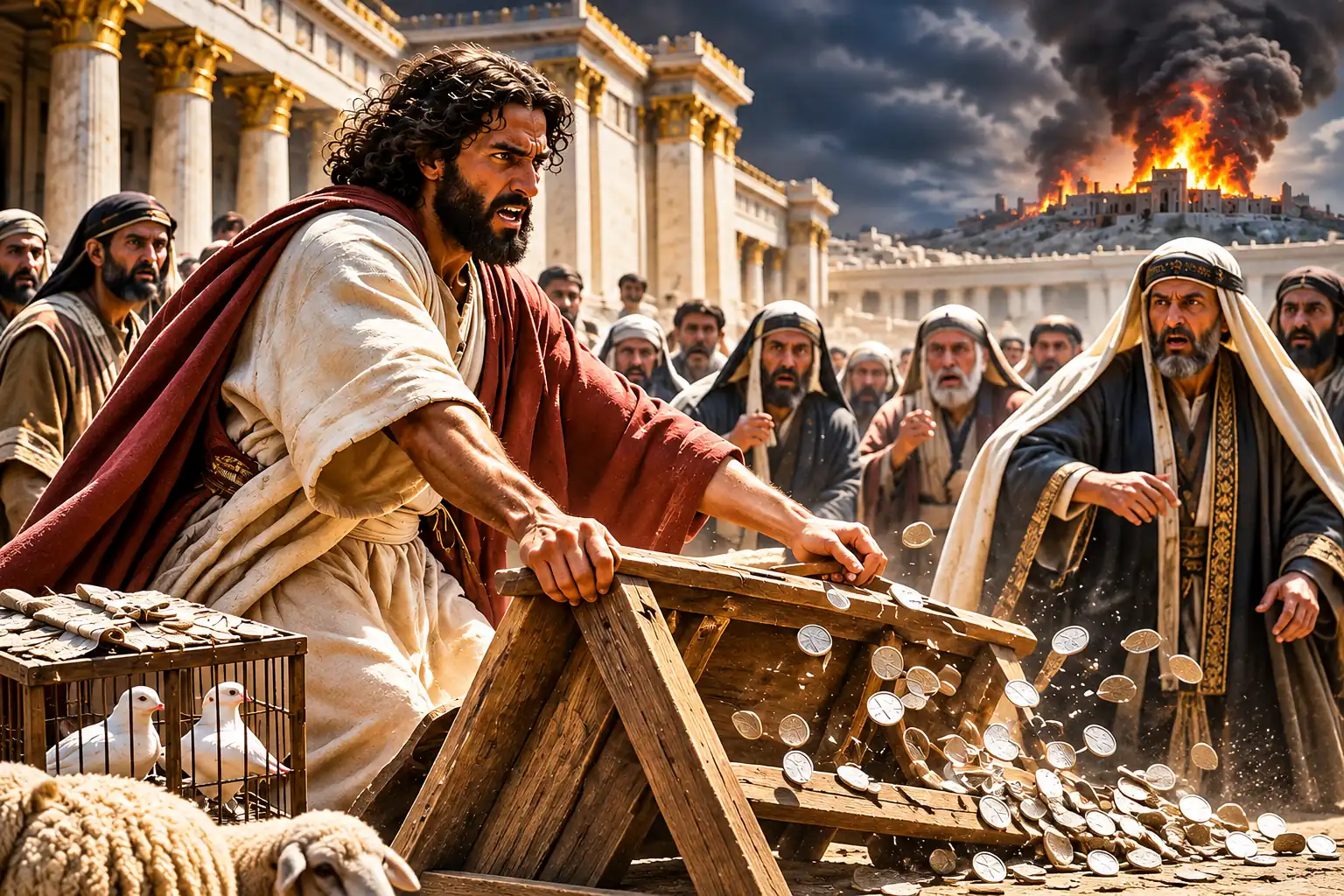
Sola Scriptura. Scripture alone, said the Reformers. So where does the Bible say that Jesus “cleansed” the temple in Jerusalem? And if it does not, are we letting the Bible shape our theology, or are we shaping the biblical narrative to suit our theology?
A Word That Isn’t There
Most Christians have been taught that Jesus “cleansed” the temple. Yet none of the four Gospels uses that word. All four evangelists use the verb ekballein, which means “to drive out,” “to cast out,” or “to expel.” It is the same verb the Gospels use when Jesus casts out demons.
The familiar heading “The Cleansing of the Temple” was added by Bible publishers and editors. It is not part of the inspired text. The heading carries a hidden inference: that Jesus restored the temple to its proper function. He did not. A missing word proves little on its own, so the question is what the act meant. The answer lies in the prophets whom Jesus was quoting.
My claim is this. Instead of cleansing or redeeming the temple, Jesus enacted a parable. He served notice on the religious leadership that a judgment was coming that would destroy the temple for good. That judgment fell in AD 70, and it coincided with his coming.
An Echo from Jeremiah
Around six hundred years before Jesus, the prophet Jeremiah stood at the gate of the first temple and spoke to a people who thought God’s house made them untouchable:
Stop putting your confidence in the false belief that says, “We are safe! The temple of the LORD is here! …
You steal. You murder. You commit adultery. You lie when you swear on oath. You sacrifice to the god Baal. You pay allegiance to other gods whom you have not previously known. Then you come and stand in my presence in this temple I have claimed as my own and say, ‘We are safe!’ …
Do you think this temple I have claimed as my own is to be a hideout for robbers? …
I will destroy this temple which I have claimed as my own …”
(Jer 7:4-14 NET)
God did exactly that, using the Babylonians.
Six centuries later Jesus stood inside Herod’s temple, the second temple, and joined two Scriptures. “A house of prayer” comes from Isaiah 56:7. “A den of robbers” comes from Jeremiah 7:11, the very verse in which Jeremiah announced the temple’s destruction.
“It is written, ‘My house will be called a house of prayer,’ but you are turning it into a den of robbers!” (Matt 21:13 NET)
The temple authorities knew the passage. They heard Jeremiah’s verdict in Jesus’ voice.
Malachi’s Sudden Visitor
About four and a half centuries before Jesus, Malachi had already announced that the second temple would face the Lord himself:
“I am about to send my messenger, who will clear the way before me. Indeed, the Lord you are seeking will suddenly come to his temple, and the messenger of the covenant, whom you long for, is certainly coming,” says Yahweh who rules over all. Who can endure the day of his coming? Who can keep standing when he appears? … (Mal 3:1-2 NET)
The messenger who prepares the way is John the Baptist. The Lord who comes suddenly to his temple is Jesus. Notice what Malachi says next: “Who can endure the day of his coming?” This is the language of judgment, not of housekeeping.
Someone will point to Malachi 3:3, where the Lord “sits as a refiner” and purifies the sons of Levi. That verse seems to favor “cleansing.” But the refining falls on people, a faithful remnant separated from the dross, and the chapter ends in Malachi 4 with a coming day that burns like a furnace. The refiner’s fire does not restore a building. It judges a generation. When the Lord came to his temple, he did not destroy it at once. He put its keepers on notice.
A Parable with a Whip
Mark’s account shows how deliberate the act was. Jesus curses a fig tree that bears no fruit, enters the temple and drives out the traders, and the next morning the tree is withered (Mark 11:12-25). The temple scene sits between the two halves of the fig tree story. The Gospel writer is saying that one action interprets the other. A tree that makes a show of leaves but gives no fruit is judged, and so is the temple.
This is how Israel’s prophets taught. Jeremiah broke a clay jar to show that God would break the city. Jesus overturned tables to show the same. Whether John 2 records a second such act early in his ministry, or places the event at the start for theological reasons, the message is the same.
The leaders understood. They demanded, “What sign can you show us, since you are doing these things?” (John 2:18) Jesus answered, “Destroy this temple and I will raise it in three days.” John explains that he spoke of the temple of his body. But why use such language? For a Jew, a threat to the temple was the last thing one wished to hear. Jesus meant to drive home a message of judgment: the temple, as they knew it, would fall. He also meant more. The divine presence now dwelt in him, so his body was the real temple of God. If they destroyed it, he would raise it, and the body of Christ would continue as God’s temple on earth. The Synoptic Gospels add that the chief priests began to look for a way to kill him after this act (Mark 11:18; Luke 19:47).
Some object that Jesus called the temple “my house” and “my Father’s house” (Matt 21:13; John 2:16), so he could not have regarded it as no temple at all. But Jeremiah did the same thing. In the same sermon in which he announced the temple’s destruction, God called it “this house that bears my name” and promised to do to it what he had done to Shiloh (Jer 7:14). The claim of ownership is exactly what makes the judgment possible. Landlords evict their own tenants.
The House Left Desolate
The verdict was consistent across Jesus’ ministry. He forgave sins outside the temple, without sacrifice or priest (Mark 2:5-7). He told the Samaritan woman that worship would soon be tied neither to Jerusalem nor to Mount Gerizim (John 4:21-24). A few days after the temple scene, he pronounced his woes on the scribes and Pharisees and on the generation that was following them:
37O Jerusalem, Jerusalem, you who kill the prophets and stone those who are sent to you! How often I have longed to gather your children together as a hen gathers her chicks under her wings, but you would have none of it!
38Look, your house is left to you desolate!
39For I tell you, you will not see me from now until you say, ‘Blessed is the one who comes in the name of the Lord!’ (Matt 23:37-39 NET. Emphasis added.)
Notice “your house.” Then, on the Mount of Olives, he predicted that not one stone of the temple complex would be left on another (Matt 24, Mark 13, Luke 21).
“This Generation”
Jesus had given his disciples a timetable. He told the Twelve that they would not finish going through the towns of Israel before the Son of Man came (Matt 10:23). He told his hearers that some standing there would not taste death before they saw the Son of Man coming in his kingdom (Matt 16:27-28). And of the destruction of the temple and the second coming that accompanied it, he said with an emphatic “Amen” that “this generation will not pass away until all these things take place” (Matt 24:34).
The apostles took him at his word. Paul wrote to the Thessalonians about “we who are alive” when the Lord comes (1 Thess 4:15). Hebrews said, “in just a little while” the coming one will come (Heb 10:37). James said the Judge was standing at the door (Jas 5:8-9); Peter, that the end of all things was near (1 Pet 4:7); and John, that it was the last hour (1 John 2:18). The book of Revelation opens by announcing things that “must happen very soon” (Rev 1:1). They called their own era “the last days,” meaning the last days of the temple and its old covenant ritual, not of the earth. The expectation fills the New Testament, and I have traced it in detail in a video presentation:
Remember Jesus saying that the Jewish nation of that day would not see him until they said, “Blessed is the one who comes in the name of the Lord!” That was the usual way residents of Jerusalem greeted fellow Israelites who came up to Jerusalem to observe various festivals and feasts. All men had to visit Jerusalem at least thrice a year. So, what did Jesus mean by that statement? Jesus was saying, You will see me again during one of your festival seasons when you greet each other saying, “Blessed is the one who comes in the name of the Lord.” Remember, Jesus was pronouncing judgment, not making holiday plans to visit Jerusalem. He was warning the Jews of that generation that He would visit them with judgment during one of their festivals. When was that fulfilled? Read Josephus. The Roman siege of AD 70 happened when Jews from all over Judaea and Galilee had been gathered in Jerusalem. The city was jam packed. The Romans shut them in. (Christians who remembered Jesus’ warning in Matthew 24: 15-21 had already fled Judaea to the east.) Thus began the intense sufferings of the residents and visitors. Due to shortage of food, women ate their babies! Finally, the city fell and the temple was destroyed.
AD 70: The Coming
Almost forty years after Jesus spoke, the Roman armies surrounded Jerusalem. The city fell, the temple burned, and Josephus, who watched the siege, records that the foundations were torn up. Not one stone was left on another. The axe that John the Baptist had seen laid at the root of the tree (Matt 3:10) finally cut it down.
Christians readily agree that Jesus’ prediction about the stones was fulfilled. But Jesus placed the destruction and his coming in the same discourse, the same sentence, the same generation. If the first was fulfilled, we have no scriptural license to move the second thousands of years into the future. The leaders had asked, “By what authority are you doing these things?” The Fall of Jerusalem was his answer. It was not simply a Roman victory. He had predicted it, and he had performed a parable of it with a whip in his hand. His followers were meant to see his hand in it.
Objections
“Doesn’t the Bible say that the temple will be rebuilt?”
After Jesus predicted the destruction of the temple, there is no record of any prophecy given about the rebuilding of that temple. The temple mentioned in association with the second coming is the second temple (2 Thess 2:4; Luke 21:24; Dan 9:27). The New Testament does not predict or command the rebuilding of a third temple.
Ezekiel’s visions are best understood in a typological way. Ezekiel’s temple, with its life-giving river flowing from the sanctuary (Ezek 47), is realized in Christ, the true temple (John 2:19-21), from whom living water flows (John 7:37-38). That same reading sees the temple extended to his people, who are built into God’s dwelling (Eph 2:19-22; 1 Cor 3:16; 1 Pet 2:5), and completed in Revelation 21:22, where God and the Lamb are the temple and no building is needed.
“But no one knows the day or the hour” (Matt 24:36).
Jesus said this to explain why his disciples must be watchful—not to push the whole discourse into the distant future. The signs he gave (wars, famine, the abomination, armies around Jerusalem) were meant to warn the generation that the season was near, while the exact day stayed hidden. The disciples’ question had been about the temple’s fall, and the entire answer stays within “this generation.”
“Didn’t Peter say that for the Lord a day is like a thousand years and vice versa?”
Yes, Peter said that to show how God transcends time (2 Peter 3:8). In the very next sentence he says, “The Lord is not slow concerning his promise … .” Peter was responding to scoffers asking, “Where is the promise of his coming?” This shows Christians of those days believed in an early second coming. Scoffers, pointing out the delay in fulfillment, doubted the promise. Peter explained the apparent delay in the Lord’s coming as his mercy towards those who had not yet repented. In his first epistle, he had written that “the end of all things is near.” Peter remained strong in his expectation of the Lord’s return during his lifetime.
“But none of the catastrophic cosmic events happened in AD 70, did they?”
Cosmic events mentioned by Jesus, Paul, and Peter in connection with the second coming were never meant to be read literally. The sun getting dark, the moon turning red, stars falling down to the earth, the sky receding like a scroll, … these are common expressions in biblical prophetic language. Isaiah used such language to describe the fall of Babylon (Isa 13:10) and Edom (34:4); Ezekiel, to describe the fall of Egypt (Ezek. 32:7-8); and Joel, to describe divine judgment on ancient Israel (Joel 2:10). Peter cited Joel’s prophecy about the darkened sun and bloody moon as being fulfilled in his own day (Acts 2:16-21). The sun, moon, and stars appeared in Joseph’s dreams (Gen 37:9-10). They denoted those in authority over him. Jesus and the apostles used cosmic imagery to describe the violent political and religious upheavals that came with the fall of Jerusalem in AD 70. Josephus’s Jewish War gives us a clear picture of the trouble Judea and surrounding regions went through during AD 67-70.
“Revelation was written around AD 95.”
The book says nothing of the events of AD 70. A book that opens with “must happen very soon” and spends chapters on judgment against Jerusalem would hardly omit the catastrophe if it were already behind the author. The internal evidence points the same way. John is told to measure a temple and holy city that are still standing (Rev 11:1-2), and the seven kings of Revelation 17:10 fit the Roman emperors of the first century. The late date rests on a later church tradition, and doctrine is settled by Scripture, not by what later writers said.
“What about the resurrection, and the end of Revelation?”
Paul tied the resurrection and the end of the age to the same hope. He spoke of “we who are alive,” and Daniel’s prophecy of the resurrection falls at the time when the power of the holy people is shattered (Dan 12:2, 7). Exactly how to understand resurrection and the new creation in Revelation 20-22 is a large subject in itself, but the New Testament’s own timetable does not leave room for waiting thousands of years.
“The early church did not teach this.”
Doctrine is not determined by the silence or the writings of later generations. It is determined by what Scripture says. If the Scriptures set the time, then what Christians later assumed, or failed to notice, cannot move it.
Why It Matters
Since the New Testament does not narrate AD 70, many Christians remain unaware of how much of its prophecy converges on that event. Some look for a rebuilt temple in Jerusalem because they believe a coming of Christ cannot happen without one. But the temple that mattered was never going to be rebuilt in stone. The Lord who came to his temple was himself the temple.
Conclusion
The question we began with was one of method before it was one of meaning. If a single editorial subheading can quietly reverse what four Gospels say, what else have we allowed our theology to write into the margins of Scripture? The remedy is not suspicion of every Bible but a slower reading: noticing the verbs the evangelists chose, hearing the prophets they were echoing, and letting an unfamiliar sense stand even when it unsettles a familiar one.
Jesus’ hearers were shaken because they heard Jeremiah in his voice. The danger Jeremiah named was never merely a corrupt building. It was a people repeating “We are safe!” even as the sword of judgment hung above them. The temple authorities, who handed Jesus over to be crucified, proved the point.
The question for us is whether we recognize the finality of the judgment that fell on that generation and its temple. If we do not, we may end up supporting the Zionists who seek to rebuild a third temple in Jerusalem. We might inadvertently participate in their genocides and endless wars. Let us not throw in our lot among those who raise a fist against the Lord Jesus by attempting to build what He pulled down using His royal, messianic authority.
For Further Study
On Jesus’ temple action and the language of “coming”
N. T. Wright, Jesus and the Victory of God (SPCK/Fortress, 1996). It treats the temple action as a symbol of coming judgment and reads the Olivet “coming” as vindication tied to AD 70.
E. P. Sanders, Jesus and Judaism (Fortress, 1985). A classic argument that Jesus’ act symbolized the temple’s destruction.
Craig A. Evans, “Jesus’ Action in the Temple: Cleansing or Portent of Destruction?” Catholic Biblical Quarterly 51 (1989).
R. T. France, The Gospel of Matthew (NICNT, Eerdmans, 2007). A leading evangelical commentary that reads Matthew 24 as largely about AD 70.
On the cosmic imagery and the first-century timeline
N. T. Wright, The New Testament and the People of God (Fortress, 1992). It argues that apocalyptic imagery is metaphor for political and historical upheaval.
Kenneth L. Gentry Jr., Before Jerusalem Fell: Dating the Book of Revelation (originally Institute for Christian Economics, 1989). It is the standard defense of the early date.
John A. T. Robinson, Redating the New Testament (SCM, 1976). It argues that the whole New Testament predates AD 70.
Within the preterist conversation
Gary DeMar, Last Days Madness (American Vision). Accessible and widely read book on the Preterist position.
Max R. King, The Cross and the Parousia of Christ (1987). The main full-preterist treatment.
James Stuart Russell, The Parousia.
William S. Urmy, Christ Came Again. New York: Eaton Mains, 1900.
On the third temple and Christian Zionism
Timothy P. Weber, On the Road to Armageddon (Baker, 2004).
Stephen Sizer, Christian Zionism: Road-map to Armageddon?. IVP, 2004.
Gary M. Burge, Whose Land? Whose Promise? (Pilgrim Press, 2003). It complements Sizer.
Josephus, Flavius. The Jewish War. Translated by Martin Hammond, introduction and notes by Martin Goodman, Oxford University Press, 2017.